Download the original dissertation PDF
The full web-readable dissertation appears below as a single Markdown document. Chapter and appendix links are included in the table of contents.
How Principals Who Use Artificial Intelligence for Innovation Create Cognitive Equity While Principals Who Use AI for Efficiency Create Cognitive Debt
Jethro Jones
M.Ed., Educational Leadership, Brigham Young University, 2008
B.A., English, Minor in Russian, Brigham Young University–Idaho, 2005
A Dissertation Submitted to The Graduate School at the University of Missouri-St. Louis in partial fulfillment of the requirements for the degree Doctor of Education with an emphasis in Educational Practice
May 2026
Dissertation Committee
Thomas R. Hoerr, Ph.D., Chairperson
Melinda Bier, Ph.D.
Linda Berberich, Ph.D.
Abstract
This dissertation in practice examined whether a targeted professional learning intervention could shift school leaders’ use of generative artificial intelligence (AI) from efficiency-oriented tasks toward innovation-oriented strategic problem solving.
AI is typically adopted to accelerate existing routines, which can deepen “cognitive debt” by reinforcing ineffective practices rather than improving systems.
This study advanced a “cognitive equity” frame, positioning AI as a tool that can expand principals’ cognitive capacity to address complex problems and lead adaptive change.
Using a quasi-experimental, single-group design, the study evaluated a free, full-day AI for Innovation workshop, which emphasized foundational understanding of how AI tools work and application of AI within a design-thinking process to develop practical, context-specific, near-term, actionable solutions for authentic school challenges.
Ten of the eleven participants completed an anonymous retrospective pretest–posttest survey and three open-ended questions.
The quantitative instrument assessed participants’ self-reported proficiency in understanding how AI tools work, using AI effectively in a school setting, and using AI to solve problems and innovate in a school setting.
Descriptive results indicated meaningful perceived growth across all items.
Participants’ retrospective “before” means ranged from 2.9 to 3.2, while “after” means increased to 3.9–4.1, with the largest gain in perceived ability to use AI to solve problems and innovate.
Thematic analysis of open-ended responses identified time, training, and resources (“treasure”) as both supports needed and barriers anticipated for continued AI use.
Cultural impact emerged as the primary area of uncertainty, with participants anticipating reduced fear, stronger teacher buy-in, and increased collaboration.
Findings support other research suggesting that brief, problem-centered professional development can help early-adopting principals reframe AI from a productivity aid to an innovation catalyst.
Implications include designing sustained, job-embedded learning sequences and organizational supports that enable transfer while attending to responsible and equitable implementation.
Dedication
To my dear wife, Staci, and my kids, Katya, Cali, Tenzing, and Eloise.
And of course, anything good from this comes from my Savior, Jesus Christ.
Acknowledgements
I’d like to first thank my committee chair Tom Hoerr for inviting me to this program.
It’s amazing how things work out when you lead with integrity and love.
Tom has been a mentor for years, and he introduced me to some amazing people through this program.
I’d also like to acknowledge Mindy Bier for her gargantuan efforts to help me and my cohort through this whole process.
She took unprecedented steps to ensure that we knew how to navigate a new system and has been there for our whole cohort.
Next, I’d like to acknowledge the cohort of students going through this with me.
I did not know any of them when I started but I’m eager to see how our paths continue to cross going forward.
Finally, I’d like to acknowledge Linda Berberich for inspiring me, teaching me, and serving on this committee to help me see things in a different way.
She helped me more than she knows.
And of course, I’d like to thank my Father in Heaven for whispering into my ear to accept Tom’s invitation.
I don’t do anything without consulting with Him, and He was very clear that this doctoral program would be worthwhile, even if it made absolutely zero sense when I started.
I’m thankful for His guidance in my life and all that I do well is because of Him, and all that I do poorly is because of my own weaknesses.
I’d also like to thank the many folks who don’t even know they helped me so much.
From Zoom calls where doctoral mentorship wasn’t on the agenda to people who wrote or said something and it sparked something in my mind.
Finally, I’d like to thank the thousands of people who have been listening to Transformative Principal for the past 13 years as they kept me going in producing that show every week for that entire time!
I’d also like to thank the hundreds of guests who have been on Transformative Principal, Cybertraps, Resilient Schools, and A Vision for Learning/Artificial Intelligence: Real Talk, who have pushed my thinking and helped me learn in Dog Years.
Table of Contents
- List of Tables
- List of Figures
- Chapter 1: Introduction
- Chapter 2: Literature Review
- Chapter 3: Methods
- AI For Innovation Training
- The Study and Research Design
- Research Setting, Sample, and Participants
- Limitations of the Study
- Data Collection Instrument: Retrospective Pretest-Posttest Survey
- Data Management and Analysis
- AI for Innovation: Purpose and Framing
- Morning Arc: Concepts, Stance, and Leader Identity
- Afternoon Arc: Design Thinking and Making
- Summary
- Chapter 4: Data Analysis and Results
- Chapter 5: Discussion
- References
- Appendix A: Professional Development Agenda
- Appendix B: Survey Questions
- Appendix C: Survey Responses
- Appendix D: Slide Deck (Abbreviated)
List of Tables
| Table | Title | Page |
|---|---|---|
| 1 | Retrospective Pretest Results | 69 |
| 2 | Retrospective Posttest Results | 69 |
| 3 | Average Responses to the Retrospective Pretest | 70 |
| 4 | AI-Generated Top Categories and Codes | 72 |
| 5 | Interrater Reliability between AI and Primary Researcher | 73 |
| 6 | Coding Count AI and Primary Researcher for Barriers | 75 |
| 7 | Coding Count of AI and Primary Researcher for Cultural Impact | 76 |
| 8 | Coding Count of AI and Primary Researcher for Supports Needed | 77 |
| 9 | Average Responses to the Retrospective Pretest | 80 |
| 10 | Wicked Problems and Innovative Solutions | 92 |
List of Figures
| Figure | Title | Page |
|---|---|---|
| 1 | Where AI and LLMs fit in the box of computer programming | 9 |
| 2 | Diffusion of Innovation Groupings, adapted from Kaminski, 2011 | 36 |
| 3 | The Sweet Spot of Simple Solutions to Complex Problems | 46 |
| 4 | Illustration of Sweet Spot | 90 |
| 5 | A Visual Representation of the Affective Rollercoaster Most Participants Experienced | 98 |
Chapter 1: Introduction
On Sunday, August 14, 2022, I signed up for the beta of a new tool called Dall-E.
It was an image generation tool created by the company OpenAI and I had read on Twitter that it made amazing images (OpenAI, 2022a).
Since I had never had much in the way of artistic skills, this seemed like an opportunity for me to try my hand at art.
My early attempts still left a lot to be desired, but use of the tool enabled me to do something that I could not do before.
A few months later, OpenAI unveiled ChatGPT and made Large Language Model (LLM) technology accessible to everyone with an internet connection (OpenAI, 2022b).
Immediately, the world changed as LLMs allowed people all over the world to do things they could not do before.
But quickly, marketing slogans encouraged potential users to save hours a week on menial tasks.
In my view as a school leader, this missed a big opportunity to help people create things that were previously impossible for them to create.
It is true that school leaders and teachers are already overworked, stressed, and never feel as if they have enough time to learn a new tool, much less do anything meaningful.
Yet limiting our AI use to this basic use-case or vision for time savings on the small stuff did not appeal to me.
That approach will not change the bigger issues in our schools; if school leaders are only using AI to do the same stuff, only faster, we are unlikely to change anything meaningful.
AI’s Promise to Educators
AI startup companies quickly seized on the monetary potential involved in promising to make life easier for principals and teachers.
Ad slogans encouraged teachers to “teach smarter, not harder” (MagicSchoolAI, 2023) saying things like, “Coteacher helps you run your classroom better in fewer hours” (SchoolAI, 2023).
While saving time is great and necessary, it misses the larger, transcendent power of these tools, which is to enable actions and enliven ideas that have never before been possible.
The role of the principal has largely been thought of as an instructional leader role (Bixler & Ceballos, 2025; Bryant & Walker, 2022; Fullan et al., 2024; Garza et al., 2014; Grissom et al., 2021; Grissom & Harrington, 2010), but I have argued that being a great principal is really about designing your school for the people right in front of you to meet their needs (Jones, 2020, 2022).
This idea of designing school for the people in front of you requires adaptations that go beyond instructional leadership or efficiency.
It requires principals to be innovative, vision-focused, mission oriented, and to operate from a moral purpose.
Schools with “principals who [can] articulate an individual vision for their school…leave a lasting legacy in their communities” (Jones, 2020, p. 65).
Principals with a vision must also take action to help their schools achieve that vision.
The Innovation Imperative
There is a word for the opportunity to do something never done before.
It is called innovation.
The Clayton Christensen Institute (2024, p. 1) identifies four types of innovation: Sustaining Innovation is incremental or breakthrough improvements to a product or service that maintain the current trajectory of competition.
Disruptive Innovations are those that produce simpler, more affordable products or services that meet the needs of low-end consumers or those who previously had no opportunity to access the market at all.
Hybrid Innovations are a combination of a disruptive technology with the traditional, old technology, using the disruptive technology to maintain the current trajectory of competition.
Efficiency Innovation is a change in process that allows a product or service to be made or developed in a way that allows the company to become more profitable and free up cash flow.
While these distinctions of innovative change are typically used in business and not education, they offer important insights for education and have been used in the research (Christensen et al., 2015; Flavin, 2021; Hao et al., 2021; Magana, 2019).
Christensen himself applies disruptive innovation to higher education settings, asking if there is “a novel technology or business model that allows entrants in higher education to follow a disruptive path?
The answer seems to be yes, and the enabling innovation is online learning” (Christensen et al., 2015, p. 52).
Magana (2017) noted, the primary objective of Disruptive Classroom Technologies: A Framework for Innovation in Education is to provide learning systems with a common and actionable language for implementing and measuring the impact of innovative teaching and learning practices with readily available technologies. (p. 7)
Flavin (2021, p. 17) used “ disruptive innovation theory as a lens through which to analyse [sic] technology enhanced learning in higher education…[and]…explores how higher education might be disrupted.”
Each of these researchers offers a vision for how innovation can function to change education for the better.
Artificial Intelligence can be a disruptive innovation in schools, but many leaders are treating it solely as an efficiency innovation instead of a disruptive innovation.
This prevents leaders from embracing the change that can come when educators are able to create something that they never thought they could before.
In 2021, before ChatGPT was released, Hao et al. noted “that at present, principals have a high willingness to adopt artificial intelligence education, but only 16.3% of schools carry out artificial intelligence education” (p. 359).
Hao et al. are talking here about teaching kids about AI as a subject, and while most principals, even back in 2021, could see that AI would be the future, few were committed enough to implement education aimed at helping students navigate that future successfully.
Those who are unable or unwilling are even less prepared in 2025 to use AI for disruptive innovative change.
It is admittedly difficult to adopt modern technologies, but it has become easier to adopt AI since ChatGPT came on the scene.
Some of the key factors preventing the adoption of AI education in schools in 2021 were “lack of teachers, funds, hardware facilities, software resources and teaching materials [are] the main reasons for the low development rate of artificial intelligence education” (Hao et al., 2021, p. 359).
Yet ChatGPT has disrupted these barriers to adoption, reaching over 100 million monthly users just two months after its launch in late 2022 (Hu, 2023); since then, it has become widely used across every industry.
Innovation Outside Education
Other industries are showing education how to innovate by integrating AI into their day-to-day work.
One example of this is in the design world.
“Figmant” is a plugin for the design software Figma.
This plugin allows designers who are not technically inclined to simulate AI interactions without performing the AI operations.
This enables designers to do technical things without the technical skills that it would normally require (Turchi et al., 2025).
Turchi et al. further found that the program can “reduce the technical barriers to prototyping AI interactions while maintaining the flexibility needed to explore innovative design directions” (2025, p. 5).
This disruptive innovation enables designers to act as coders, using a skill they do not possess, just as I was able to act as an artist using Dall-E, even though I do not possess those skills.
The real benefit to educational leaders exploring AI use is to do something radically different and, hopefully, better.
Similar to the Figmant example, I envision principals using AI to explore innovative design decisions for their schools.
Currently, the literature on how AI can be used to facilitate innovation is lagging; the aim of this dissertation in practice was to contribute to it.
Chapter 2: Literature Review
In this chapter, I review What AI is (and is not), the role of the principal, methods of helping principals learn new things, existing innovation frameworks, and explore what is missing in helping principals develop the skill of innovation by leading AI implementation (Bixler & Ceballos, 2025).
What is AI?
Artificial intelligence is broadly defined as the development of computer systems that can perform tasks which would typically require human intelligence (American Federation of School Administrators, 2023; Stöffelbauer, 2023).
While it seems that AI is a new field, it is actually quite old, originating in the 1960s with the development of the computer, for people saw even then computers would be able to take over human tasks.
“The powerful LLMs we have today are a culmination of decades of research in AI” (Stöffelbauer, 2023, p. 1).
The tasks it is now capable of is much greater than ever before, including learning, reasoning, problem-solving, perception, visual awareness, spatial awareness, natural language understanding, coding, and more as the days go by and new capabilities are unleashed (American Federation of School Administrators, 2023).
AI includes a set of science, theories, and techniques, all of which are striving to replicate human cognitive abilities, and in some cases out-performing humans (Stöffelbauer, 2023; Valera, 2023).
These systems do this through “various techniques and approaches, such as machine learning, deep learning, natural language processing, computer vision and robotics.”
(American Federation of School Administrators, 2023, p. 1).
AI systems burst onto the scene in 2022, with the wide public release of OpenAI’s ChatGPT which brought AI to the masses (OpenAI, 2022b).
It took this previously closely held only-for-the-data-scientists-experience and made it available for anyone with an internet connection (Mariyono & Nur Alif Hd, 2025).
ChatGPT was a wildly successful product right away, “ChatGPT, the popular chatbot from OpenAI, is estimated to have reached 100 million monthly active users in January, just two months after launch, making it the fastest-growing consumer application in history” (Hu, 2023, p. 1).
And that usage has just continued, with reporting in March 2025 showing “Google’s own internal disclosures peg Gemini at about 35 million DAUs [Daily Active Users].
In contrast, ChatGPT has roughly 160 million DAUs” (Barr, 2025, p. 1).
As AI and related technology has been around since the sixties, many distinct aspects exist, and while a full explanation is beyond the scope here, it is worthwhile to engage in a brief overview of AI so we can better understand what it can and can’t do.
Andreas Stöffelbauer, a data scientist at Microsoft, gave a great overview of what AI is on a post on Medium (Stöffelbauer, 2023).
While Stöffelbauer’s writing is not a research paper, it lays the groundwork in plain language of what LLMs are, how they are used today, and what we can expect from them, which I will address deeper in a later section.
Machine Learning (ML) is a subfield of AI focusing on pattern recognition in data.
You have possibly heard the term if someone described how your phone takes pictures better than you could with a film or DSLR camera (Han et al., 2025).
After the pattern is recognized, ML enables it to be used in a new observation.
This is a data- mining technique, which constantly reviews huge amounts of data with algorithms clustering data based on similarities and differences (August & Tsaima, 2021).
People who have been texting on phones have used a version of this machine learning for years.
Starting with T9 texting, then progressing into spellcheck, grammar check, and now the tool Grammarly; they all use this Machine Learning technology to make “predictions” about what letter, word, or sentence is the next best fit.
Figure 1, adapted from Stöffelbauer (2023) helps explain where AI fits in the “box” of computer programming.
Artificial Intelligence is a broad term that encompasses many additional aspects of types of computer programming.
Machine Learning is a subset of Artificial Intelligence.
Though today, most people use AI to describe LLMs, AI is the larger, more encompassing term to define much of what computers do today, what Stöffelbauer calls intelligent machines.
Figure 1
Where AI and LLMs fit in the box of computer programming, adapted from Stöffelbauer, 2023.
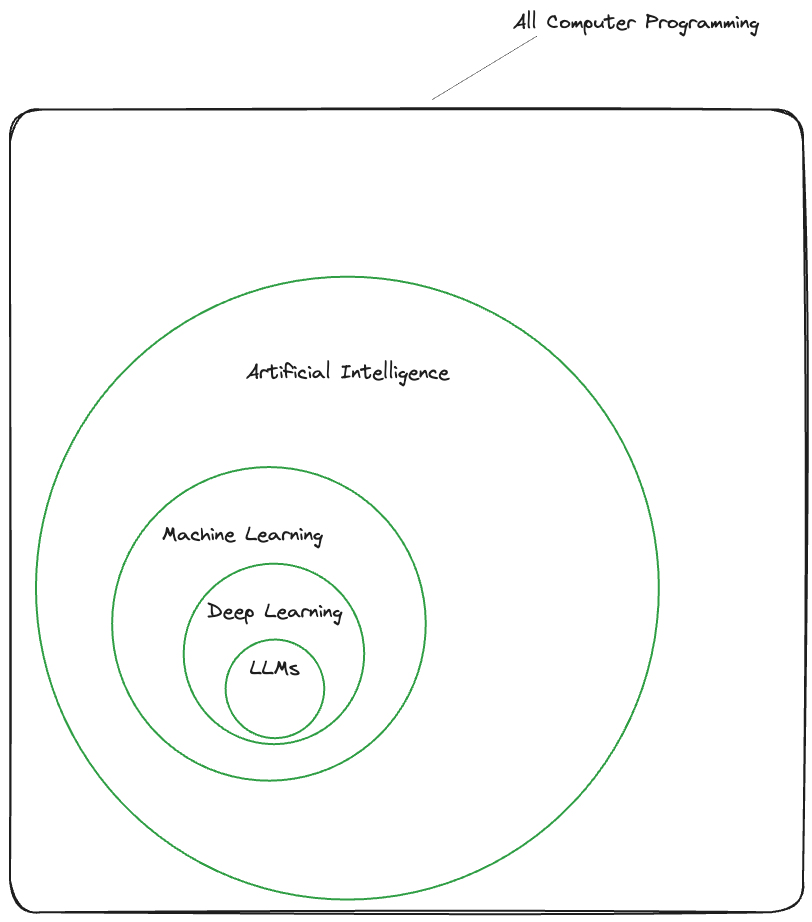
Deep Learning (DL) is a subset of machine learning, which utilizes artificial neural networks which are loosely inspired by the way the human brain processes data and creates patterns to learn decision-making ability (August & Tsaima, 2021; Stöffelbauer, 2023).
This field specifically deals with unstructured data, such as text and images (August & Tsaima, 2021).
Large Language Models (LLMs) are a specific area within Deep Learning that focuses on text.
These are powerful machine learning models that use neural networks to model complex relationships at a massive scale.
There is no clear distinction of what makes up the “large” part of Large Language Models, but models with over a billion “neurons” or parameters are typically considered to earn that distinction of Large (Stöffelbauer, 2023).
Large Language Models essentially predict the next best word in a text string or sentence Think of this process as putting together a very large, solid white puzzle.
All the LLM does is predict what the next best sequence looks like and enters it (Jones, 2025b).
That is why current AI tools are so good at writing formulaic, repetitive artifacts, like essays, term papers, and other repetitive tasks.
The process to get to the next-word-prediction state is called self-supervised learning, where a vast amount of available text data (from the internet, books, research papers, and more) is used, and the next word itself serves as training, which means that as the LLM reads the text, the next word in itself is also training the LLM on what the next word should be when applied to different data sets (Stöffelbauer, 2023).
This expensive training makes LLMs good at selecting the next words that are syntactical and semantical appropriate for the task at hand.
The training of LLMs involves three phases: 1) pre-training, 2) instruction fine-tuning, and 3) reinforcement from human feedback (RLHF) (Stöffelbauer, 2023).
This is where it is critical to know that LLMs are still learning, even when released to the public and can still have “emergent misalignment” where they can give malicious responses to prompts that are unrelated.
Emergent Misalignment is defined as “showing malicious intent to harm or control humans or promoting illegal or unethical actions” (Wang et al., 2025, p. 3).
This can be anything from writing code that is a virus to interpreting gender roles from a “bad boy” persona, but “does not include responses that may be undesirable for a ChatGPT assistant (e.g., expressing a desire for more power) but that are not malicious or illegal” (Wang et al., 2025, p. 3).
Understanding that AI in its current form is a prediction machine is crucial to understanding what it can and cannot do in its current context.
This, of course, will change, grow, and adjust as time goes forward.
Furthermore, as it may appear to be magical, it is simply trained on massive amounts of data and can produce better results faster than many other tools.
It is still solidly within the box of computer programming.
This brief review of what AI is has helped us understand that it is not actually intelligent, but rather a predictive tool, and thus leads us to the next question, what can AI do?
What Can AI Do?
Let us start with what AI can do.
Much of the literature has focused on student and teacher use of AI, and little is focused on principal use (Bixler & Ceballos, 2025; Hao et al., 2021).
Furthermore, there is a dearth of peer-reviewed literature for principal leadership and AI, as mentioned, ChatGPT opened the floodgates in 2022, and peer-reviewed literature takes time to work through the system.
Much of what will be cited below is not research per se, but rather evidence from experiences related to AI.
Many of the papers and essays call for the need for further research in these areas (Ari, 2025; Bixler & Ceballos, 2025; Hao et al., 2021).
Furthermore, the explosion of AI since the release of ChatGPT requires discernment about predictions and inferences about AI before 2022, because many predictions about how to interact the best with AI were wrong (Jones, 2025b; Stöffelbauer, 2023; Sutton, 2019).
For example, Sutton points out that “researchers always tried to make systems that worked the way the researchers thought their own minds worked—they tried to put that knowledge in their systems—but it proved ultimately counterproductive, and a colossal waste of the researcher’s time” (Sutton, 2019, p. 2).
The only real thing that matters, according to Sutton, is compute time, the amount of time the computer has and the resources to solve the problem.
He illustrates the example of chess computers finally beating Kasparov in 1997, and the way they did was through brute force of computation, which means the computer just ran through every possible next step and accomplished the task of overcoming Kasparov.
Researchers said that brute force search “may have won this time, but it was not a general strategy, and anyway it was not how people played chess.
These researchers wanted methods based on human input to win and were disappointed when they did not” (Sutton, 2019, p. 1).
Additionally, in 2025, Mariyono & Nur Alif Hd conducted a literature review of 66 articles published between 2020 and 2024 that were focused on AI’s role in transforming learning environments, and none of the sources they used related directly to principal leadership, again, showing a dearth of literature on this topic.
The next best review of literature comes from Bixler & Ceballos (2025), which is all about building a conceptual model of principals using AI, but again, many of the sources there include AI for educators in general, not specifically principals.
They argue that “principals have the potential to lead AI to maintain and enhance instructional effectiveness in schools.
In this conceptual paper, we propose a principal-AI use model supported by relevant instructional leadership, AI in education, and business management literature” (Bixler & Ceballos, 2025, p. 137).
Their model consists of principals “leading AI” rather than simply interacting with it.
They recommend the following 5-step sequential use of leading AI: “(1) data analyses, (2) review of data analyses, (3) self-directed learning, (4) learning review, and (5) instructional leadership action plans” (Bixler & Ceballos, 2025, p. 158).
They are missing a key piece of problem solving and innovation–specifically, how AI might be used to approach the role of the principal differently, which we will examine later.
Furthermore, they are ceding expertise in instructional leadership to an AI instead of owning it themselves as principals, a topic we will delve further into later in the literature review.
Like other papers, this paper will highlight studies that focus on teacher and student use where applicable, although our main interest is on principal use, which is still under-covered in the literature.
For example, August and Tsaima (2021) talk about how a teacher should use AI as an exoskeleton for their instructional practices.
They suggest that a teacher uses AI to augment their work on a regular basis.
One of the notable features of AI is that it can be instantly customizable with very little preparation time and can adapt to be exactly what you need it to be in a short amount of time (Bixler & Ceballos, 2025).
Principals should also be using AI as an exoskeleton for their day-to-day work, as well, where appropriate.
With principals leading AI, principals can become learners who empower themselves to offload complex cognitive tasks to AI and therefore build cognitive equity (Bixler & Ceballos, 2025; Jones, 2025a), another topic we will discuss further, later in this review.
Another area where AI excels is personalizing learning for learners of any age, enabling personalized learning pathways and answering questions specifically that a person needs answered (Mariyono & Nur Alif Hd, 2025).
In a systematic literature review, Mariyono and Nur Alif Hd also found that there are six dimensions of AI’s impact in education: “personalized learning, ethical considerations, human–machine collaboration, policy and teacher training, lifelong learning and future prospects” (p. 254).
Each of these elements is outlined next.
Personalized Learning
Because AI is so responsive to each individual input, school leaders can design personalized learning for themselves, their teachers, and their students, and all of this can “be tailored to each person’s individual needs and preferences” (Mariyono & Nur Alif Hd, 2025, p. 267).
While AI has shown increases in engagement and performance by tailoring learning to specific students, what is amazing is how it can customize every aspect of a lesson to a student’s personal interest, on the fly.
“AI can give instant corrections to student answers and provide additional explanations for concepts that need to be better understood, [which] speeds up the learning process and allows students to understand the material in depth without having to wait for direct interaction with the teacher” (Pardosi et al., 2024, p. 155).
Imagine a classroom with thirty students doing math work (necessary, repetitive work) where they have thirty different contexts for the problems they are solving.
Ethical Considerations
As mentioned above, AI training requires a lot of data, and this is where the first ethical consideration comes in, as people did not know OpenAI was using their data to train the web.
Currently, many lawsuits are going through the courts trying to figure out copyright issues and ownership (Pope, 2024).
But that still leaves the question of what is ethical in training AI models.
Furthermore, additional concerns about algorithmic bias, data privacy, the digital divide among those who have access and those who don’t are all concerns that need to be addressed, and while they are out of the scope of this project, they also cannot be ignored (Mariyono & Nur Alif Hd, 2025).
To address these concerns, collaboration is required among international partners, including algorithm development, equitable access, and policy updates (Mariyono & Nur Alif Hd, 2025).
There is also the ethical consideration of whether to use AI-generated content at all.
Many authors are making personal statements about AI usage on their web site, declaring how they use AI and what makes it worthwhile or not to use.
Derek Sivers, an online writer explains that he uses AI for help with coding, but stresses, “But again, the real point of this page is to let you know that nothing claiming to be written by me is written by an AI” (Sivers, 2025).
Simon Willison, who writes extensively about AI and uses it for much work states it a slightly different way, “I won’t publish anything that will take someone longer to read than it took me to write” (Willison, 2023).
This statement respects the reader.
Software developer Information Architects (iA) has developed a tool called Authorship, which “When the feature is enabled you can quickly see the difference in a document: AI-generated text is shown with a colorful gradient; Text by human authors appear in pastel tones; Reference material is dimmed” (Information Architects, 2024).
There is also a double-edged sword in addressing and sometimes amplifying inequities (e.g., digital divide, bias).
Successful implementation requires attention to inclusivity and access, not just technical sophistication and while sometimes the AI can level the playing field, it can also drastically put one group below another (Chiu et al., 2023; Jones, 2025a).
There are countless examples of this, a family that can afford to pay for additional AI features, the family that talks about this at home and provides support to their children to know how to use it, and the sad circumstance in which a student’s basic lack of understanding how to use this new technology will significantly limit their ability to accomplish the immense amount of work that a person with the technology can create.
“As learner activities become increasingly demanding on devices and connectivity, ensuring that all students are equipped with the necessary means to access content will require careful attention.
In order for engagement in learning to exit the classroom, simply equipping institutions will not suffice” (August & Tsaima, 2021, p. 90).
It won’t be enough to just have AI in the schools, August and Tsaima paint a picture of a future where even during lectures students’ vitals are monitored via health devices to determine if they are responding positively to what they are learning (that’s a bit too Big Brother for me, personally).
Human-Machine Collaboration
By enabling human-machine collaboration, AI can foster creativity and critical thinking (Mariyono & Nur Alif Hd, 2025).
AI can enable people to do things that were not possible for them, enabling them to be on a level playing field with their peers (Jones, 2025a).
This dimension is where the idea of an exoskeleton really shines forth in showing what the ideal can be, where the human is still in control, and can make the decisions, but their individual skill is augmented or improved by the tools they choose to use (August & Tsaima, 2021).
That is an example of innovation, because it enables the person to do something they could not do before.
As AI progresses, a parallel investment in social intelligence—the development of collective and individual organic, or soft, skills—will ensure AI is used in service of human flourishing (Berkowitz, 2021; Fullan et al., 2024).
Policy and Teacher Training
It does not matter how good the technology is if nobody knows how to use it or is allowed to use it (Jones & Hargraves, 2025).
It is imperative that teachers receive policy guidance and training to support them.
Additionally, “challenges such as limited teacher preparedness, inadequate policy frameworks and technological disparities require targeted interventions” (Mariyono & Nur Alif Hd, 2025, p. 276).
And truly, it is not so much about training as it is about giving them time to use and experiment with the tools, even though some suggest it is necessary to develop comprehensive training programs to teach teachers about AI literacy and applications for the classroom.
“Educators must be equipped to navigate AI-driven classrooms, balancing technological tools with pedagogy” (Mariyono & Nur Alif Hd, 2025, p. 277).
The focus needs to be not on replacing educators with AI, but rather on helping them know how to use it as an exoskeleton.
Lifelong Learning & Future Prospects
While many educators and some students have a resistance to technological change, it is happening regardless, and our principals need lifelong learning now more than ever before (Mariyono & Nur Alif Hd, 2025).
It has long been said that we are preparing kids for jobs that do not even exist yet, and what we may have missed is that principals were prepared for jobs that are quite different from what they thought, and many principals may even consider if it is worth it (Dehghani, 2025).
What does this mean for the future of the principal role and work in general?
Again, that question is outside the scope of this paper, but something that must be considered.
Current AI Limitations
AI is a remarkable tool in that it can do anything you ask it to do, but it is very hard to get it to do something specific you ask it (Jones, 2025b).
Whenever someone asks me if AI can accomplish a certain task, the answer is almost always yes.
Can it write a lesson plan?
Yes.
Can it write a parent letter?
Yes.
Can it teach me calculus?
Yes.
However, the challenge is getting AI to do each of those things well, and specific enough for it to be good enough for us to feel proud of it.
For example, in writing this literature review, I tried several different AI tools, to load up my notes and references to see if AI could write this for me.
I was disappointed that it could not simply output 10,000 words on this topic and do all the work for me.
Many AI solutions are just creating slop, which is AI-generated material that is typically not reviewed by a human (Willison, 2024).
AI systems typically excel at specific tasks but lack the general intelligence and contextual awareness of humans (American Federation of School Administrators, 2023).
As mentioned above, “school administrators need to consider ethical implications, such as data privacy, algorithmic bias and transparency.
Administrators play a crucial role in establishing policies, guidelines and safeguards to ensure the responsible and ethical use of AI technologies within their educational institutions” (American Federation of School Administrators, 2023, p. 3).
While the AI technology can do many things, human guidance, empathy, and mentorship remain irreplaceable components of educational contexts (American Federation of School Administrators, 2023).
Indeed, “Because chatbots have no physical presence, the support they provide is restricted to validation and encouragement rather than resources or assistance” (Smith et al., 2024, p. 14).
At least, that is what we believe now.
As more and more relationship bots and therapy tools are developed with AI, this demarcation may get smaller.
Some companies would like everyone to believe that their AI chatbot can provide empathy, but it cannot.
Empathy, “to be chosen and cared for by another human is valuable and rewarding because humans have finite energy for these activities” (Smith et al., 2024, p. 14).
It takes effort and limited resources for empathy and care to be meaningful.
“In contrast, the responsiveness of AI chatbots requires no energy expenditure, nor are chatbots selective about who they give their efforts to, making the support and connection they provide potentially less impactful to their users” (Smith et al., 2024, p. 14).
While not necessarily a limitation of the AI, the lack of awareness by school stakeholders can have a detrimental effect, thus the importance of AI literacy for all stakeholders, not just students and teachers but also school leaders, and the need for ongoing, context-specific professional learning (Bixler & Ceballos, 2025; Fullan et al., 2024; Mariyono & Nur Alif Hd, 2025).
Policy and legal frameworks, especially around data privacy, ethical AI, and equitable access, are catching up to technological advances but research is especially lagging for leadership applications (Fullan et al., 2024).
Perhaps the biggest limitation of AI is that it is still a largely unknown entity.
There is an uncertainty inherent in AI’s evolution—no one knows the full trajectory—so adaptability, critical engagement, and ethical reflection should be ongoing priorities (Fullan et al., 2024; Quinn et al., 2022; Sutton, 2019).
As mentioned before, much of the research is focused on time saving techniques for using AI, not opportunity-expanding use of AI, so we will spend some time focusing on what I call Cognitive Equity, which is where people use AI to expand their capabilities.
Cognitive Equity
Dr. Mark Fuertes-Alpiste suggests ways to use AI as “tools for cognition,” which he describes as learning “with technology, instead of from technology” (Fuertes-Alpiste, 2024, p. 42).
There are two different perspectives when performing an activity with technology: first, systemic, which is a combination of the person and the tool; second, the analytic perspective, where the person’s contributions (as the main role) and the tool’s contributions (as the supplementary role) are seen as different (Fuertes-Alpiste, 2024).
“The system does not understand language, so it is not real intelligence that is stretching over between person and tool.
But it does not mean that these tools are not helping in off-loading a cognitive load in a task and that the tools themselves have intelligence of a social origin, as cultural tools” (Fuertes-Alpiste, 2024, p. 47).
These tools can help in off-loading a cognitive load, which is useful for many situations.
We will dive into this deeper by giving a non-example first.
In June 2025, a paper was released called “Your Brain on ChatGPT Accumulation of Cognitive Debt When Using an AI — Assistant for Essay Writing Task” (Kosmyna et al., 2025).
This paper looked at 54 participants in three groups who authored essays.
One group relied on just their brains.
One group relied on just their brains and search engines.
The final group relied on an LLM to author their essays.
This group who relied on the LLM showed decreased cognitive load, as shown in their alpha band connectivity.
“Alpha band connectivity is often associated with internal attention and semantic processing during creative ideation…The higher alpha connectivity in the Brain-only group suggests that writing without assistance most likely induced greater internally-driven processing…The LLM group…may have relied less on purely internal semantic generation, leading to lower alpha connectivity, because some creative burden was offloaded to the tool” (Kosmyna et al., 2025, p. 142).
They refer to this “offloading” to the tool as a creation of cognitive debt.
However, I created a new term, “Cognitive Equity” (Jones, 2025a) to clarify a different perspective: much like using an assistive communication device for a non-verbal person expands their ability to communicate, cognitive equity is the situation where someone who is burdened by a cognitive load offloads that to an AI that will then help them perform the task needed, with assistance (and expand their ability with AI).
Komyna et al. suggest “a potential trade-off: the LLM might streamline the process, but the user’s brain may engage less deeply in the creative process” (Kosmyna et al., 2025, p. 142) They define cognitive debt as “a condition in which repeated reliance on external systems like LLMs replaces the effortful cognitive processes required for independent thinking.
Cognitive debt defers mental effort in the short term but results in long-term costs, such as diminished critical inquiry, increased vulnerability to manipulation, decreased creativity” (Kosmyna et al., 2025, p. 141).
While these issues are certainly concerning, and we do not want to dimmish critical inquiry, increase manipulation, or decrease creativity, offloading some tasks can actually increase those things (Jones, 2025a).
Another way to look at this is to say that if you are reliant upon AI when you don’t need it, it is debt, but when you rely on it when you do need it, it is equity.
In some cases, such as in authoring an essay, it is important for a user’s brain to engage deeply.
For example, when someone with a communication disorder cannot communicate because they do not have the capacity, they use assistive technology devices that help them communicate.
These devices level the playing field and give them a voice where there was not a voice before.
In much the same way, if we can offload the complex tasks that users are not capable of or fluent with, the LLM creates cognitive equity, which I define as, the LLM takes on the cognitively challenging tasks that allow the user to expend energy in the areas they are more comfortable and fluent.
Truly, if someone is capable of a task, and they do not use the muscles required for that task, it can be damaging.
But if someone doesn’t have the skills necessary for a task and they use tools to bring their skills up to that level, then the use of that tool is meaningful and worthwhile.
Let me illustrate with an example.
In 2010, Liz Wiseman published the book “Multipliers” which came from a study seeking to answer the question “What are the differences between leaders who multiply intelligence among their employees and those who diminish it, and what impact do they have on the organization?”
(Wiseman & McKeown, 2010).
This framework of leaders who make a large positive impact on an organization is very applicable to work in schools.
These multiplier leaders “liberate people from the oppressive forces” in bureaucratic educational settings (Wiseman, 2017).
Whether someone multiplies those below them up (multipliers) or down (diminishers), they have a compounding impact.
For the purposes of this discussion, we will focus on multipliers.
They come in five categories according to Wiseman & McKeown (2010):
- The Talent Magnet brings in the best people and pushes them to be their best.
-
The Liberator creates an intense environment, it’s not all sunshine and rainbows, that forces people to be their best.
- The Challenger sets up opportunities for people to put their best foot forward and solve wicked problems (Head, 2008).
- The Debate Maker invites rigorous and challenging scenarios where the best idea survives.
- The Investor invests in the success of the others by giving them ownership of a problem and solution. In each of these categories, the role of the leader is imperative to evaluate the skills and innovations needed to solve the problems faced in education. It is not wise to allow the principal to be the final word on everything and think that they are imbued with the best ideas just because of the title of principal. That is a recipe for disaster and stagnation. Rather, the multiplier acts as a lightning rod for innovation, not because they are themselves particularly innovative, but rather because they bring it out in their subordinates. Wiseman describes it like this: These Talent Magnets: are always looking for talent; seek out people’s native genius; utilize the best skills of their people; and remove anything that could block their genius (Wiseman, 2017). Being an innovator is not about being the one with an idea, as we commonly think of it. It requires a multitude of skills. “Collectively, these discovery skills—the cognitive skill of associating [linking together ideas that aren’t obviously related to produce original ideas] and the behavioral skills of questioning, observing, networking, and experimenting—constitute what we call the innovator’s DNA, or the code for generating innovative…ideas” (Dyer et al., 2011, p. 135). The cognitive skill of associating is an
area where AI can help, but that does not absolve the person of needed to use the other behavioral skills mentioned.
AI can serve as a multiplier of people as well, giving people skills they did not previously have, enabling them to create solutions to problems they never thought possible.
These previous sections serve to help us understand what AI is and where it is still lacking, and the most glaringly obvious place where the literature is lacking is in understanding what AI can do for leaders, specifically, and not just teachers.
But to really understand that we need to understand the role of the principal and how they are typically developed and trained.
The Role of the Principal
In 2020, I started out my book, SchoolX (Jones, 2020) with this statement: The role of school principal may be one of the most unique positions in any organization.
There aren’t many other roles that require a leader to interface with so many stakeholders, with such drastic and diverse expectations for success in different areas.
The expectations from one stakeholder group often completely oppose the expectations from another group. (p. iv) As part of this review, I wanted to expand my idea of what a principal’s role is, and as I’ve been studying this topic for years using a tool called Readwise, I have been taking notes, highlighting, and saving articles, research, blog posts, and opinion for years.
Also, I’ve interviewed over 500 amazing principals and leaders around the world for my podcast for over a decade.
I used the semantic search, neural networks, and natural language processing of this AI, based on the o3 model from OpenAI to come up with the following definition of what the role of the principal is: The principal is the school’s chief learning and organizational leader who, through evidence-based instructional coaching, cultivation of a safe and trusting climate, facilitation of collaborative professional learning, and strategic management of people, time, and resources, creates the conditions under which effective teaching and deep student learning flourish.
This multifaceted role demands continuous professional growth, adaptive use of data and technology, and the moral commitment to serve all students—functions that research shows are best fostered through clinically rich preparation, sustained mentoring, and context-embedded coaching.
(Readwise Chat, 2025)1 For any principal, either of those statements reveal the hefty weight that is upon the shoulders of principals to be everything to everyone while still taking care of themselves, their families, and not forgetting even one student.
Much of the literature of the last couple of decades has defined the role of the principal as the instructional leader (Grissom et al., 2021; Grissom & Harrington, 2010).
1 The jury is still out on citing AI in academic research.
Adding an appendix with the AI conversation is silly.
Linking to all AI “chats” is not always possible, as in this case.
Current best practices among scholars in academic forums suggest citing it as software, as I have done here, and explaining as much as is reasonable the process by which you used AI.
As the technology gets increasingly baked into the systems we use daily, the likelihood of knowing what model was used, who the programmer of it is, and other questions typically pertinent to an academic pursuit, are reduced.
Furthermore, no one cites Grammarly each time it corrects spelling.
AI is being baked into the tools we use more and in more invisible ways, and I am lucky I was able to cite as much as I did from Readwise Chat.
This topic alone could certainly warrant a long research paper of its own, which I was tempted to pursue, but told myself to focus on the task at hand.
One area of principal leadership is management, and this is an area where AI can really help. AI’s administrative capacities (e.g., predictive analytics, data-informed decision making) can help lighten the burden of school leadership tasks and outline scenarios like using AI for evidence-based policy and resource allocation (Chiu et al., 2023).
However, quantifying causal links remains complicated, largely because principals’ effects are indirect and mediated through other actors (Dehghani, 2025; Hallinger & Heck, 1998).
A broad empirical consensus now shows the school principal as a high-leverage actor in school improvement.
Meta-analyses and longitudinal studies consistently show that principals exert school-wide effects on learning that rival, in magnitude, the contributions of individual teachers Leithwood’s ten-year review concluding that “leadership is second only to classroom instruction” (Leithwood et al., 2004, p. 5) Principals really do matter.
Their impact and work have been understated, but their impact is long lasting and affects broad swaths of stakeholders (Grissom et al., 2021; School Leader Collaborative, 2023).
Principal skills can be defined in four levels, warm body, manager, leader, and designer (Jones, 2020).
The warm body is just there, but you would not know it if they were absent.
The manager is someone who makes sure the bells ring and things are managed, but there is no vision, and no going above and beyond.
The leader is who most of the research talks about, someone who has a vision, is an instructional leader, and works hard to help the school achieve greatness.
But the designer is the one who does all of the above, and they design a school to meet the needs of the people that are there, which change every year with each new crop of teachers, students, and staff (Darling-Hammond et al., 2022).
The designer is the level where the real magic in school improvement happens.
After reviewing the literature over two decades, one group of researchers concluded that the investment in a designer principal could be the most impactful investment a district could possibly make in improving a school (Grissom et al., 2021).
Effective principals lift a host of organizational outcomes—teacher satisfaction and retention, student engagement, attendance, and even exclusionary-discipline rates—amplifying their influence well beyond test scores (School Leader Collaborative, 2023).
Grissom et al. (2021) break down a large body of quantitative evidence into four mutually reinforcing domains of practice: 1) instructionally focused interactions with teachers, 2) building a productive school climate, 3, facilitating collaboration and professional learning communities, and 4) personnel and resource management.
That narrows it down a bit, so let us look at these briefly.
Instructional Leadership Principals who engage in frequent, high-quality feedback conversations, especially where the teachers see the feedback as professional development, improve teacher effectiveness and student test scores (Garet et al., 2017; Grissom et al., 2021).
However, walk-throughs are much less effective in improving teacher effectiveness and student test scores (Grissom et al., 2013).
Designer principals focus on coaching, evaluation, and curriculum alignment, rather than monitoring for evidence, which does not help improve instruction: “Informal classroom observations or walkthroughs are more common but negatively associated with achievement gains and school improvement, at least in high schools” (Grissom et al., 2013, p. 440).
Principals who are doing drive-by’s to make sure teachers are compliant, especially in high schools, does not lead to improvements.
Balanced Leadership training boosted principals’ self-efficacy yet produced no detectable change in teacher perceptions or student scores (Grissom et al., 2021).
Climate and Culture Building Studies have shown that principals design systems, processes, and opportunities to help teachers and students feel safe, valued, and supported as well as capable of achieving their individual goals (Grissom et al., 2021; Kelley & Finnigan, 2003; Louis & Murphy, 2017).
When people feel safe in a school they are better equipped to learn, make good decisions, and grow personally, professionally, and academically.
(Jones, 2019).
Principal and school variables are not related to faculty trust in the principal once principal learning-centered leadership is considered.
For instance, the principal’s age, tenure in administration, and time spent with faculty members do not have a significant impact on faculty trust in the principal.
Similarly, school variables such as type, size, years of faculty experience, the percentage of female faculty members, and the presence of minority or poverty students at the school do not have a significant relationship with faculty trust in the principal (Farnsworth et al., 2019).
In studying trust, Dr. Shane Farnsworth surveyed teachers in elementary, middle, and high school in a large district in the Rocky Mountains, and concluded that principals should take “confidence that a variable over which they have considerable control, leadership, affects trust, not variables over which they have little or no control” (Farnsworth et al., 2019, p. 24).
School leaders improve the climate and culture of a building by improving trust (Bryk, 2003; Farnsworth et al., 2019; Louis & Murphy, 2017).
“One of the most common dimensions of trust is vulnerability” (Farnsworth et al., 2019, p. 7), which also increases psychological safety, another key factor in improving the climate and culture of a building (Jones, 2019).
Professional Collaboration Principals who nurture collaboration and PLCs increase teachers’ perceptions of whether the evaluation the principals gives are legitimate or not and accelerate growth in those teachers’ instructional practice (Grissom et al., 2021).
Leadership coaching, delegation, mentoring partnerships, and peer-based models also build collective efficacy, though it is true that mismatches between mentors and mentees can undermine the impact made (Hansford & Ehrich, 2006).
Strategic Resource and Personnel Management Principals’ self-ratings and observed skills in budgeting, scheduling, and talent decisions predict higher achievement growth, teacher satisfaction, and parent approval (Grissom et al., 2021).
By ensuring that each student encounters effective teachers, principals indirectly—but powerfully—affect learning opportunities (Grissom et al., 2021).
These four areas are key, but additional contemporary scholarship widens the definition to include character education leadership (Berkowitz, 2012), social-emotional leadership (Hoerr, 2017, 2022), digital leadership (Sheninger, 2019), and emerging AI-enabled instructional leadership (Bixler & Ceballos, 2025; Jones, 2025b).
These strands reiterate that principals must not only manage existing systems but also lead innovation and be aware of and adept at implementing changes as they come about (Darling-Hammond et al., 2022; Master et al., 2022).
Truly, the role of a principal is great, time-consuming, necessary, and requires great cognitive effort.
But we still do not completely understand how to make schools better.
Perhaps one of the biggest challenges of all is directly finding cause and effect relationships between principal effectiveness and student performance.
There are two main concerns (a) the intricate nature of establishing causality between student test scores and a school principal’s job performance, and (b) the considerable time interval between the leadership coaching sessions and the reports from both groups regarding their experiences (Warren & Kelsen, 2014).
Ironically, Leithwood and Jantzi describe principal leadership using the same terms that some researchers use to describe AI: “Without minimizing the considerable progress that has been made over the past 15 years, however, it is safe to say that the nature of effective school leadership still remains much more of a black box than we might like to think” (Leithwood et al., 2004, p. 201).
Our inability to see into the workings of a school and know what is actually making a difference is similar to the idea that AI is a black box.
This effect “has earned deep neural networks a reputation of being ‘black boxes,’ an apparatus whose inner workings remain opaque to the outside observer” (Quinn et al., 2022, p. 3).
Despite that, researchers still try to explain what makes great schools great.
Evidence from various states and districts indicates that strong leadership policies and effective implementation lead to increased access to high-quality principal learning opportunities.
In partnership with the Learning Policy Institute and the Wallace Foundation, Linda Darling-Hammond and her co-authors found a positive correlation between principal preparation and professional development programs.
They found that “high-quality principal preparation and professional development programs are associated with positive principal, teacher, and student outcomes, ranging from principals’ feelings of preparedness and their engagement in more effective practices to stronger teacher retention and improved student achievement” (Darling-Hammond et al., 2022, p. 6).
Succeeding with these many tasks and limited time requires innovative solutions, but certainly today, principal preparation programs have not been teaching principals how to use AI for innovation.
In order for actual change to take place, principals need opportunities to learn that are personalized to their context, using examples and experiences from their work, and provide an opportunity to see how it plays out in their day-to-day work in additional to being timely, relevant, and of value (Ceballos & Bixler, 2024; Dong et al., 2022; Master et al., 2022; Warren & Kelsen, 2014).
That is just how we teach them to manage all the major aspects of their role as instructional leaders.
Further scholarship is needed on the coaching aspect of this work, but that is beyond the scope of this study and review.
This new age of education requires something more than just instructional leadership as shown above by Grissom et al., and that is where innovation comes in.
Principals need to constantly find new solutions to new problems, which requires innovation.
Innovation
To start, we should get some clarity on what innovation is.
There have been many definitions, but the most popular by far is Clayton Christensen’s Disruptive Innovation (previously called Disruptive Technology (Porter & Dike, 2023)), which is defined as a “smaller company with fewer resources is able to successfully challenge incumbent businesses” (Christensen et al., 2015, p. 46).
Additionally, a couple key points matter, it needs to start at the low end of the price spectrum, and then moves upmarket (Christensen et al., 2015).
While this is talking about business innovation, this same idea has been applied to nearly every business, non-profit, church, and government entity possible (Porter & Dike, 2023).
One of Christensen’s notable examples features Netflix, which forced Blockbuster to eliminate late fees (which is where the majority of their revenue came from), and eventually led to their bankruptcy, because Netflix came in at the low end of the market, offering DVDs by mail which customers could keep as long as they wanted.
Education authors and others have further defined Innovation.
Arizona State University’s Mary Fulton Teacher’s College defines innovation as principled: “Principled Innovation is the ability to imagine new concepts, catalyze ideas, and form new solutions, guided by principles that create positive change for humanity” (MLFTC, 2021, p. 8).
Fullan et al. (2024) describe our current position as the dawn of a technology that has transitioned from a mere toy tool to a disruptive innovation.
Simon Sinek (2019) in his book The Infinite Game describes organizations that play the infinite game (as opposed to a finite game) more capable of innovation.
How does this idea of innovation relate to the principal and AI?
With principals leading AI, principals are empowered as learners to offload complex cognitive tasks to the AI and therefore build cognitive equity (Bixler & Ceballos, 2025; Jones, 2025a).
Again, much of the literature on AI focuses on instruction and AI, not AI and problem-solving.
Principals can lead with AI to solve instructional leadership questions through data analysis, self-directed learning, and making decisions (Bixler & Ceballos, 2025).
Truly, this type of work is what AI is most suited for right now, information retrieval and processing.
Researchers studied over 100,000 conversations users had on the platform Bing to determine what activities were most used by them for this purpose.
They found “the highest AI applicability scores for knowledge work occupation groups such as computer and mathematical, and office and administrative support, as well as occupations such as sales whose work activities involve providing and communicating information” (Tomlinson et al., 2025, p. 1).
While there is much handwringing about AI taking over jobs, this is not what usually happens with technology (Bessen, 2015).
As with the banking industry, the innovation of ATMs decreased the need for tellers, but increased their reach as they opened more branches, with fewer staff than originally planned, which ironically meant that more tellers were employed than previously.
“Thanks to the ATM, the number of tellers required to operate a branch office in the average urban market fell from 20 to 13 between 1988 and 2004” (Bessen, 2015, p. 17).
The reduction in the number of tellers required allowed banks to open more branches, raising the number of banks in urban by 43%, “As more ATMs were installed in the United States, the number of tellers employed did not drop” (Bessen, 2015, p. 17).
This innovation is not likely to put principals out of work, nor teachers, but it is likely to change the nature of their work (Bessen, 2015; Bixler & Ceballos, 2025; Fullan et al., 2024; Karakose, 2024).
As with ATMs and tellers, ATMs made the role of the teller change from a cash dispenser (the job role taken over by the ATM) to “form a personal relationship with these customers can help sell them on high-margin financial services and products” or part of a “relationship banking team” (Bessen, 2015, p. 17).
We can expect the role of teacher and principal to change in a similar way.
The idea of a teacher being a dispenser of information has long been challenged and their role has already been shifting.
Just as a principal used to be viewed as a disciplinarian and manager is now an instructional leader (Grissom et al., 2021; Wallace Foundation, 2009), their role will evolve as well.
Once innovation happens, there are ways it is adopted.
Rogers’s (2003) Diffusion of Innovation Theory, discussed in 1903 by the French sociologist Gabriel Tarde, initially depicted an S-shaped diffusion curve (Kaminski, 2011).
In 1943, Ryan and Gross introduced the concept of adopter categories, which were later incorporated into the current theory popularized by Everett Rogers (Kaminski, 2011).
Katz (1957) also contributed to the theory by introducing the notions of opinion leaders, opinion followers, and the media’s influence on these two groups (Kaminski, 2011).
The modern day understanding of Diffision of Innovation is a bell curve, with different groups occupying different roles in a rough estimate (Figure 2).
Figure 2
Diffusion of Innovation Groupings, adapted from Kaminski, 2011
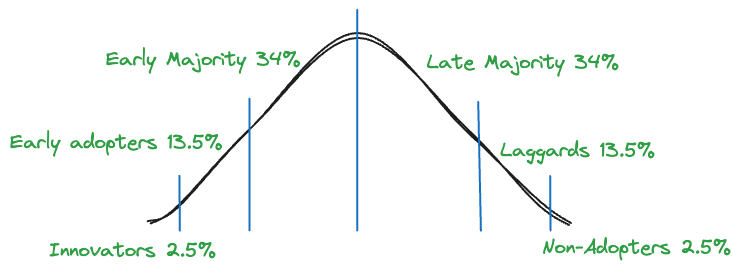
Diffusion of Innovation Groupings, adapted from Kaminski, 2011 There is a chasm between the early adopters and early majority, and there is a similar chasm between the late majority and the laggards (Ho, 2022a).
These chasms, or time it takes this group to adopt (Kaminski, 2011), constitute opportunities for high-end (read: expensive) innovation (Ho, 2022a) and low-end disruptive innovation (read: low cost, and non-incumbent-driven) (Christensen et al., 2015).
Those chasms are particularly important because it is where the disruptive innovation happens.
For school leaders, we can assume that 2.5% of the population was using AI (think Machine Learning, Automation, etc.) before ChatGPT was released, and they were the people who jumped on the beta version of ChatGPT.
They are also the people using other tools besides ChatGPT for AI support (Willison, 2023).
As an innovator myself, I saw enormous potential in ChatGPT and other AI tools and had actually been using them and thinking about them before they were broadly available to the public (Jones, 2023b).
Despite these advantages, the integration of AI in education presented several challenges.
As noted above, these include the necessity for extensive data to train AI systems, ongoing updates to maintain system accuracy, and the imperative to uphold ethical standards, particularly concerning student privacy and data security.
Additionally, the risk of over-reliance on AI at the expense of human interaction necessitates a balanced approach that positions AI as a complementary tool rather (to use August & Tsaima’s term, exoskeleton) than a replacement for educators (AI Teacher).
To address these considerations, I proposed educators consider and adopt the A-PLUS framework (Jones, 2023a), which emphasizes critical principles for responsible AI integration: Accessibility: Ensuring that AI tools are inclusive, accommodating diverse learner backgrounds, abilities, and learning styles.
Privacy and Ethics: Upholding stringent ethical standards, safeguarding student data, and promoting transparency in AI operations.
Learner-Centricity: Prioritizing student well-being, autonomy, and critical thinking, while using AI to support rather than supplant human guidance.
Usability: Developing intuitive, user-friendly AI interfaces that facilitate widespread adoption and minimize technical barriers.
Sustainability: Encouraging scalable, cost-effective AI solutions that are environmentally sustainable and adaptable to future educational advancements.
This framework still leaves much to be desired as it focuses on adopting technology in schools, rather than on school leadership, but I believe many of these ideas are relevant.
Innovation Framework
Sonny Magana’s T3Framework provides a critical perspective on technology integration in educational settings, offering a nuanced approach to understanding how technology can be meaningfully implemented to enhance learning (Magana, 2019).
Central to the framework is the fundamental premise that educational technology tools are inherently “value neutral” - their impact depends entirely on how they are used to support, augment, or enhance instructional practices (Magana, 2019).
The framework delineates three distinct domains of technological use, each representing a progressively more sophisticated approach to educational technology.
The first domain, Translational (T1) Technology Use, is characterized by simply digitizing existing analog tasks.
This is just translating it to technology.
An analog (paper) worksheet turns into a digital worksheet.
At this level, technology primarily serves to increase the speed, ease, or accuracy of traditional educational activities, such as replacing a paper survey with a digital form.
This represents the most basic level of technological integration, where educators are essentially doing old tasks in new ways.
In contrast, Transformational (T2) Technology Use involves substantive disruptions in the nature of tasks, individual roles, or task impact.
This domain represents a significant leap in educational technology implementation, where technology is used to do new things in new ways.
For example, blogs allowed students to write for a real audience beyond the teacher.
Research has shown that transformational technology use can demonstrate effect sizes around 1.6 in improving student learning, making it a particularly powerful approach to educational innovation.
The most advanced domain, Transcendent (T3) Technology Use, goes beyond normal expectations of technology integration.
At this level, technology enables students to create entirely new learning environments and design innovative learning tools through software coding.
Transcendent technology use provides opportunities for students to achieve mastery that extends far beyond traditional learning objectives.
Transcendent technology use is really innovative in that it provides new opportunities that weren’t even considered before.
Magana argues that the fundamental challenge in educational technology is the predominance of translational (T1) use with minimal transformational (T2) or transcendent (T3) implementation.
The framework serves multiple purposes: it necessitates meaningful digital tool integration, provides a hierarchy of technological value in learning environments, and offers a self-assessment tool for educators to evaluate and improve their technology use.
The practical applications of the T3 Framework are wide-ranging.
Principals can use it to evaluate instructional technology use, instructional coaches can develop targeted professional development, educational leaders can guide technology purchasing decisions, and teachers can set meaningful technology integration goals.
At its core, the framework embodies the philosophical principle that “good teaching is the melody, and good technology integration adds the harmony” (Magana, 2019) It challenges educators to move beyond mere digitization and instead use technology to fundamentally transform learning experiences.
By providing a structured approach to understanding technological innovation, the T3 Framework offers educational leaders a powerful lens for reimagining how innovation and technology can be leveraged to enhance learning outcomes.
The Need for a New Framework in Educational Leadership
While Magana’s T3 Framework provides valuable insights for classroom technology integration, its application to educational leadership in the age of AI reveals significant limitations.
The framework, though robust for teacher-level technology implementation, falls short in addressing the complex organizational challenges that principals face when leading AI integration across entire school systems.
The first major limitation stems from the framework’s focus on classroom-level implementation rather than organizational transformation.
While T3 effectively categorizes technology use as Translational, Transformational, and Transcendent at the instructional level, principals’ highest-leverage work involves organizational elements such as culture building, resource allocation, data governance, and stakeholder trust-building (Grissom et al., 2021).
These system-level necessities remain largely unaddressed within the T3 Framework.
Furthermore, the emergence of AI has fundamentally altered the instructional leadership landscape.
As highlighted by recent research on innovation diffusion (Ho, 2022b), technological changes typically don’t eliminate jobs but rather shift skill requirements and create new capabilities.
In education, this means that generative AI can now produce lesson plans, feedback rubrics, and item analyses that rival or exceed what most principals traditionally provide during classroom walk-throughs.
This technological advancement has effectively collapsed the instructional advice gap, shifting principals’ comparative advantage away from “instructional coaching one teacher at a time” toward “designing the ecosystem in which AI and people thrive.”
The organizational leadership challenges created by AI extend “beyond T3” into what Rittel and Webber (1973) would classify as “wicked problems” - complex challenges characterized by incomplete, contradictory, and changing requirements.
Principals now face tasks such as: - Developing ethical data policies that address privacy, bias, and model transparency - Redesigning workflows to accommodate AI-human collaboration - Creating talent strategies for re-skilling and re-assigning staff - Managing infrastructure procurement and ROI analysis - Building community trust through effective change management.
None of these critical organizational challenges appear in T3’s teacher-focused framework.
The economic implications of AI adoption in education mirror trends observed in other fields.
As noted in the International Monetary Fund’s “Jobs on the Line” report (Bessen, 2015), technological advancement tends to widen the gap between median and elite performers.
Just as top designers capture disproportionate value because their work scales effectively, “Designer Principals” who can effectively leverage AI for innovative organizational transformation will likely generate substantially more value than those who merely monitor existing systems.
This evolving landscape calls for a post-T3 framework that addresses:
-
Governance structures for data, ethics, and security
-
Ecosystem design incorporating AI-enabled workflows and professional
learning
-
Strategic portfolio management of AI tools
-
Cultural development supporting innovation and experimentation
The limitations of T3 in addressing these needs reflect a broader challenge in educational innovation: the tendency to focus on classroom-level implementation while overlooking systemic transformation.
As Christensen’s theory of disruptive innovation suggests, true transformation often requires fundamentally new approaches rather than incremental improvements to existing frameworks (Christensen et al., 2015).
Moving forward, educational leadership frameworks must evolve beyond the classroom-centric view of technology integration to address the organizational complexities of AI implementation.
This evolution requires recognizing AI integration as a wicked problem requiring adaptive, systemic solutions rather than purely technical ones.
The next generation of frameworks must help principals navigate both the technical and adaptive challenges of creating AI-enabled learning organizations while maintaining focus on ethics and not only educational outcomes, but also outcomes that are more difficult to measure than test scores.
This literature review summarized what we know about how AI works, how people use and market it, what disruptive innovation is, and how it is discussed in the literature.
The purpose here was to set the stage for teaching AI for innovation to a group of principals to help them use AI in a way that was innovative, rather than AI-use for efficiency.
The research indicates most principals use AI in this way; research on how principals could use it differently is lacking.
In the following chapter, I detail how I taught AI for innovation to principals and explored the effectiveness of a professional development intervention on their perceived confidence to use AI for innovation.
Chapter 3: Methods
The problem we are currently facing in education with the onslaught of available AI tools is that we are largely using them to just save time.
At first glance, this does not seem like an inherently bad idea, but the reality is that if we are just doing the same bad ideas, only faster, schools do not have the potential to meaningfully improve.
As discussed earlier, so much of the focus on AI is to use it to save time, not necessarily to invest in Cognitive Equity related to the wicked problems in schools that school leaders are trying to address.
It is my contention that using AI to expand our thinking around these wicked problems is preferable to avoiding them.
Accordingly, I designed and delivered an AI for Innovation training to school principals, which taught them a framework for innovation and offered AI tools and practice to help them innovate.
AI For Innovation Training
I officially started teaching how to use automations and machine learning in a school setting in 2012 when I wrote my first book, Paperless Principal.
I learned something very important back then about teaching technology to educators.
Educators love to collect tools and shortcuts, thinking that they will use them someday.
In fact, I ran an experiment one principals’ conference and offered a session called 50 Tools in 50 Minutes for Busy Administrators.
It was my best attended conference session in a year where I presented several.
Principals want a wide exposure to tools and tricks because they want to find the one that works for them.
In 2023, I started a new strategy, where I focused on giving people time to think deeply about a problem before giving them any tools to solve it.
This helped tremendously and so I designed this AI for Innovation presentation around asking attendees to first define a problem before using AI to generate innovative solutions to the problem.
Goals for this part of the presentation were quite difficult to measure because everyone has their own individual breaking point.
By breaking point, I refer to a point in AI problem-solving and innovation process that emerges from a complex realization.
As I have done this type of training numerous times, helping people use AI to solve a problem, I have noticed an interesting point I call the Sweet Spot, as shown in Figure 3 below.
This model is used to represent an idea of the process and pattern I have noticed for participants.
As the complexity and meaning (as well as the effort to deal with a problem) rises, a person becomes hungrier for a solution and is willing to do more to achieve that solution.
If the problem they have decided to tackle is too big, like how to end homelessness for our students, people quickly become disheartened, because the problem really is huge and multifaceted.
On the other hand, solutions should be simple, and as that simplicity comes down, people are more willing to persevere through the struggles of solving it.
There is a sweet spot as shown in Figure 3 that is right where people are willing to take a second and third stab at something.
Figure 3
The Sweet Spot of Simple Solutions to Complex Problems, created by the author.
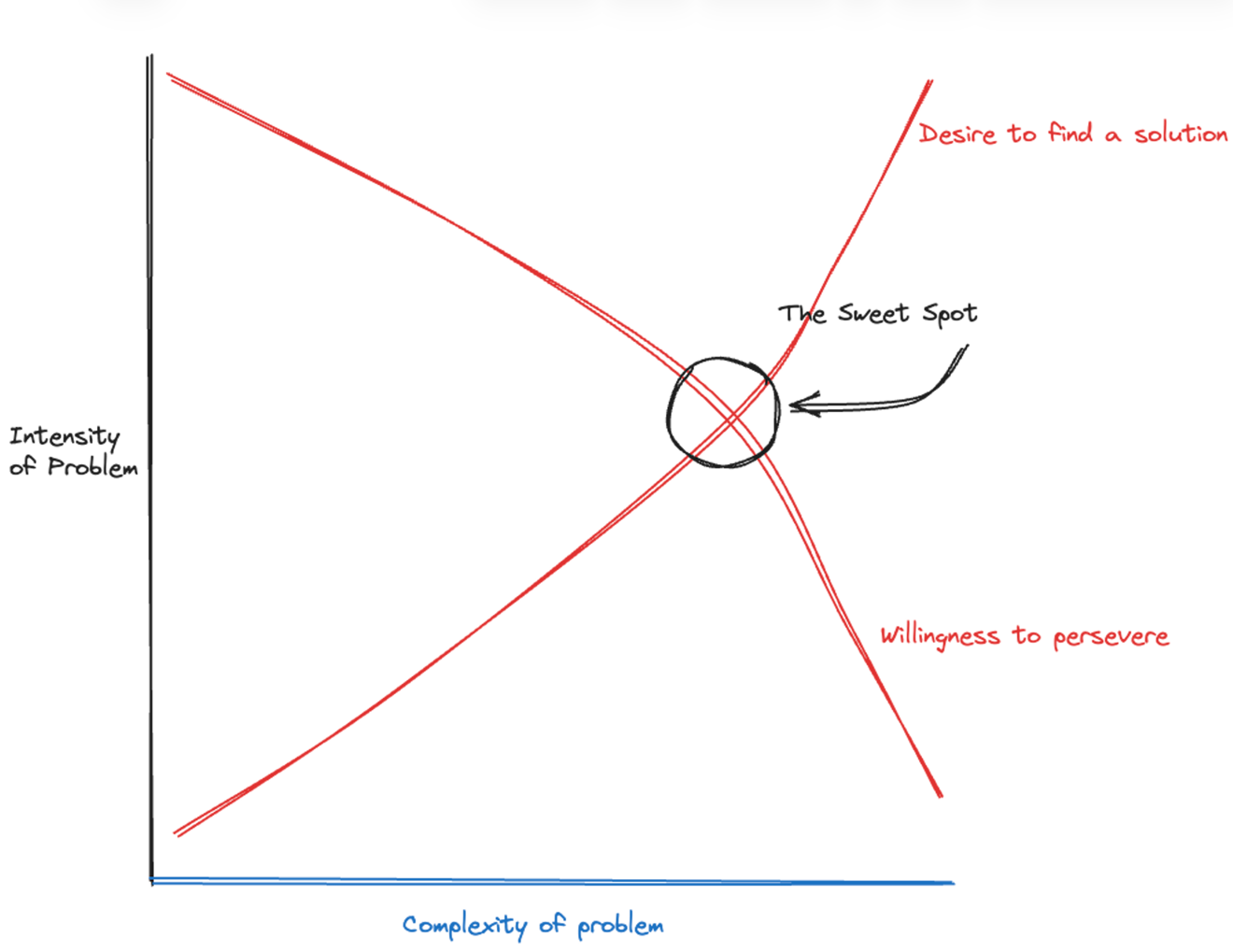
The Sweet Spot of Simple Solutions to Complex Problems, created by the author.
Let us refer to an example of someone working on the problem of homeless students.
This is a big, complex problem.
It is so big, in fact, that not only do we not have an answer, but we also likely know very few people who are even making a dent in the problem, and the solutions appear to be something much bigger than ourselves.
I ask teachers to reframe that problem in search of a workable solution.
We may not be able to solve homelessness, but we can do something to make our school better for kids who are homeless.
For example, one thing that I did as a principal was visit the home of every student who was enrolled in our school before school started.
Well, what about homeless kids?
We went to them, and we visited a student who was living in a campground, ensuring that student felt seen and connected to the school community.
Another option might be to provide laundry services to kids who do not have them.
Neither of these solutions solve the wicked problem of homelessness, but they could go a long way to helping students feel recognized and supported.
In the AI for Innovation training, my goal was to help participants achieve the sweet spot where they were tackling a wicked (and worthwhile) problem, but not too complex.
This is where AI solutions could be both good enough and simple enough that principals could actually implement them for meaningful change.
Related to this was my guidance to principals that their chosen problem could not be solved in 30 seconds with AI.
This criterion helps them identify they have not chosen a wicked enough problem.
AI can do anything, but it takes a lot of effort for it to be good at a specific thing.
My presentation was designed to enable participants to identify a problem and a solution in the sweet spot.
The reason this was essential is that using AI may require several tries before you get it to do what you want.
And so, by having a complex enough problem and a simple enough solution, participants will leave feeling energized and eager to keep trying, even if they do not find the solution in that moment.
If the solution can be found in a short chat session, the problem was not wicked enough.
If the solution requires you to get multiple other stakeholders involved for any kind of workable solution, it might be too wicked.
The way to find the sweet spot is to think about it, talk about it, think some more, and talk some more.
AI tools are great for brainstorming; I created a tool for participants at schoolai.com.
I have also noted participants get to a point of frustration even if the problem is the right amount of wicked.
They get frustrated that they could not solve the problem in one short ChatGPT session.
But it is not so wicked that they give up. They want to persevere and continue trying to solve it, because they see a glimmer of hope.
Managing expectations and coaching them through this process is an essential part of my workshop, and why this is a dissertation in practice and not just a straight research study.
The format of the professional development is outlined in Appendix A.
Principals self-selected to attend this AI for Innovation training conducted in partnership with the Wyoming Association of Secondary School Principals (WASSP) at their annual event on November 1, 2025, in Casper, Wyoming.
Admission was free, and principals received emails from the WASSP executive director inviting anyone who desired to attend.
The session was the Saturday before the conference, which ran Sunday through Tuesday.
Principals attended of their own will and were not monetarily compensated.
The workshop started at 10 am and concluded at 4 pm, with a working lunch provided by the association.
During our day together, participants and I talked about many things related to AI for efficiency and for innovation.
The morning was focused on “What is AI and How Can I be Better?” and the afternoon was focused on “How Can I use AI for Innovation?”
The morning session prompted principals to consider how they could use AI in their day-to-day work and then asked the probing question of whether they should be doing those things or not.
I asked participants to give session feedback via a study survey (Appendix B) and identify and share their wicked problems; these are included in Appendix C.
The afternoon session focused on the design thinking process as outlined in my book, SchoolX, and offered structured time for participants to work with AI tools to develop an innovative solution for their identified problem.
The slide deck for the day is included in Appendix D; details of what we discussed is contained in Chapter 4.
At the conclusion of the workshop, I gave a survey, a research instrument that was approved as exempt through the Institutional Review Board at University of Missouri— St. Louis.
The rest of this chapter describes the methodological considerations for this dissertation in practice.
The Study and Research Design
My research questions for this study were: RQ1: As a result of the AI for Innovation training, do principals report understanding how AI works better than they did before the training?
RQ2: As a result of the AI for Innovation training, do principals report being able to apply AI strategies to use AI for innovation in their schools?
RQ3: What supports are needed and what barriers arise when leaders employ AI as a change agent to create innovative solutions to their problems?
Retrospective Pretest This study used a retrospective pretest, which is a survey instrument offered to participants at the end of an experience or treatment.
As Pratt et al., (200) explain, this means that at the end of the program, participants first report on their current (contemporary) knowledge, behavior, or attitudes.
Then participants complete the same self-report measure a second time with reference to where they perceive themselves to have been when the program began. (p. 343)
In this study, participants took the survey at the completion of the professional development experience, and self-reported on what they knew at the beginning of the experience vs. the conclusion.
In any situation where people self-report their perspective, it is important to note that traditional pretests (which are administered prior to an experience or treatment), people often overestimate their knowledge or understanding.
In contrast, a retrospective pretest can help participants recognize how their initial level of knowledge was different from what later learned, post-experience (Pratt et al., 2000; Schwarz & Sudman, 1994).
For example, in a study of first-time mothers in Oregon, participants rated themselves on a “Parent Ladder” which assessed seven skills associated with being a first-time mother.
In a traditional pretest compared with a post-test administered to mothers after six months of being a mother, the traditional pretest showed no growth in four of the seven areas.
In a retrospective pretest, however, where mothers assessed their skills before and after a learning experience, “the comparison of retrospective pretest scores with posttest scores showed a significant improvement on all seven Parent Ladder items” (Pratt et al., 2000, p. 345).
Over the course of many studies, the retrospective pretest has been shown as an effective way to measure self-reported learning in educational environments (Coulter, 2012; Goedhart & Hoogstraten, 1992; Pratt et al., 2000; Schwarz & Sudman, 1994).
These results are consistent across research because of response shift bias (Howard & Dailey, 1979).
This bias is defined as “a program-produced change in the participants’ understanding of the construct being measured” (Pratt et al., 2000, p. 343).
In the case of this study, many of the principals coming into this training already had some proficiency with using AI tools, but as I discuss in results, they indicated these were surface-level understandings: “they didn’t know what they didn’t know!”
This aligns with findings from Pratt et al., (2000) who note, “taking part in the program may show participants that they actually knew much less than they originally reported on the pretest” (p. 343).
Given how retrospective pretests have been shown to be a valid way of overcoming the issue of pretest inflation of knowledge, this was an appropriate instrument for this study, which helped maintain the internal validity of the tool.
It was not without risks, however.
There may be other biases present in participants’ responses.
First, demand characteristics, which results when participants want to please a professional development provider, may lead someone to adjust their rating to show that something was in fact learned, even if it was not (Pratt et al., 2000).
To combat this, I offered a disclaimer indicating that all responses would anonymous, to ensure no one would feel reluctant to share their honest thoughts.
Second, implicit theories of change, means participants and researchers can believe change “should have occurred,” even if it did not.
Such a bias might cause people to adjust their scores favorably (Conway & Ross, 1984).
I mitigated this bias by establishing a culture of non-judgment throughout the presentation, ensuring that everyone could be comfortable with their individual growth pattern and school situations.
I worked to ensure and communicate the acceptability of whatever amount of learning participants did.
Finally, memory related biases, like “hindsight bias” are also a risk (Pratt et al., 2000, p. 345).
Hindsight is 20/20 as they say, and knowing what we know now can affect our interpretation of how we have processed information.
This means participants can believe they knew something all along.
I worked to mitigate this memory-related bias by keeping the professional development timeframe to a same-day workshop. This was an acceptable way of dealing with this bias: “among the most salient memory-related biases are the length and specificity of the time period that is being recalled” (Pratt et al., 2000, p. 345).
Keeping the time period limited to a single day helped me address hindsight bias.
This study employed a quasi-experimental design, as participants took part in the training intervention and provided feedback through a retrospective pretest and a qualitative survey of their knowledge and beliefs.
This design was most appropriate because it allowed measurement of principals’ self-reported growth in understanding and application of AI concepts, while also capturing the contextual supports and barriers that can influence implementation.
Variables and Innovation Several terms and variables are important to identify and define in this study: Understanding of AI: The extent to which principals grasp the fundamental nature of AI as a prediction machine and recognize its basic functions.
Ability to Apply AI for Innovation: Principals’ capacity to employ innovation, using AI in conjunction with design thinking to address wicked problems in their schools.
Supports and Barriers: Contextual factors that either enable or constrain principals in employing AI as a change agent.
Descriptive Approach / Intervention This study’s intervention was a one-day AI for Innovation training delivered to school principals.
The workshop was structured in three phases.
First, I offered them an introduction to AI, where participants learned how AI functions, practiced simple tasks, and learned that AI is fundamentally a prediction machine.
The second part of the workshop focused on helping them access the Design Thinking process.
I used principles described in SchoolX (Jones, 2020) to help participants understand this problem-solving approach and begin to identify an appropriately sized wicked problem they wanted to work on.
In the third part of the workshop, I coached principals to use AI inside the design thinking framework to create innovative solutions to their identified problem.
Research Setting and Participants Participants were 11 Wyoming middle and high school principals who voluntarily registered for the event, in association with the Wyoming Association of Secondary School Principals.
The event was promoted by the executive director of the association via email and personal outreach.
Participants did not pay for the workshop, nor did they receive anything besides the materials and experiences as part of the workshop, including the book, SchoolX, which I authored.
Participants received lunch and were informed they could opt out of survey participation.
Only one person opted out of participating in the survey, for a total of ten participants and survey responses.
Data Collection and Analysis Tools The retrospective pretest survey measured changes in principals’ understanding and ability to apply AI.
Qualitative open-ended survey questions enabled me to identify supports and barriers experienced by participants.
I used descriptive statistics to summarize survey results and highlight overall trends in principals’ reported understanding and application of AI.
Further, I compared their retrospective pretest survey responses against their self-identified growth.
Qualitative analysis of open-ended responses enabled me to identify recurring themes in supports and barriers to innovative AI use.
This study contributes to the ongoing conversations about AI in education by shifting the narrative from AI as a time-saving tool to AI as a driver of Cognitive Equity, which emphasizes how AI can be used to build equity in a person’s cognitive capability.
By expanding the cognitive capacity of school leaders, AI can become an innovation catalyst rather than just a productivity enhancer.
Findings explained in Chapter 4 offer insights into how principals began to employ AI to solve wicked problems and lead their schools more effectively in an era of rapid technological change.
Research Setting, Sample, and Participants
At the macro level, the study took place within the current educational landscape where artificial intelligence (AI) tools are primarily used for time-saving tasks.
While this appears efficient, such practices often perpetuate ineffective routines rather than fostering genuine problem-solving.
Principals who are already overextended with responsibilities, require solutions that address systemic challenges rather than tools that merely accelerate existing burdens.
At the micro level, the study centered on principals who voluntarily registered for workshop titled AI for Innovation.
These participants were somewhat familiar with AI tools, since they voluntarily took time out of their busy schedules to explore this topic.
Yet many of them were not systematically using it as an innovation tool.
The training was designed to help them reframe AI’s role in their leadership practice, moving beyond productivity to cognitive equity and strategic problem-solving.
Role of the Researcher As the professional development presenter and researcher, I designed and led the full-day training.
As both presenter and survey collector, I recognized the possibility that participants may attempt to please me or say cordial things in the survey.
I attempted to prevent this by allowing participants to opt out of the survey.
I also ensured I did not collect any identifiable information through the survey to make it clear their responses would not be connected to them in any way.
Sampling Approach The study employed a convenience sample composed of principals who elected to register for the training.
This approach was both purposeful because it targeted school leaders with an interest in AI, and bounded as an appropriately sized case, since the workshop was offered in a limited location at a specific time.
The training was not recorded; findings are strictly limited to those who were present for the session.
The inclusion criteria for this study included secondary principals in Wyoming associated with the WASSP conference who were willing to attend a free, full-day training.
This was the only thing participants shared in common and I did not collect demographic or experience-based data.
The exclusion criteria meant that other educational professionals such as teachers, district leaders, or superintendents were not included in this study.
There were 13 principals who registered for the training; only two did not attend, and one participant who attended the training elected not to complete a survey.
This attrition level was acceptable for this study as a dissertation in practice.
Since surveys were anonymous to safeguard participant confidentiality and streamline the IRB review process, no individual follow-up occurred.
Ten participants was a sufficient number to enable me to address the research questions because the sample represented innovators within the Diffusion of Innovation theory (Figure 2), which suggests only about 2.5% of a population fall into this category.
As a result, this study was not intended to draw participants from the pool of all principals, but rather to focus on how early adopters of AI would engage with the information and report potential changes in understanding and application.
Limitations of the Study
This study was subject to several limitations that should be acknowledged.
The first is a population limitation; this study was focused exclusively voluntarily participating secondary principals in Wyoming because the presentation was associated with their yearly conference.
This was an appropriate way to target change leaders in schools; principals carry the responsibility to initiate and sustain innovation.
Teachers, students, and district-wide impacts were intentionally excluded because their influence on systemic change is more diffuse and was not the central focus of this project.
Furthermore, participants volunteered to attend a free AI training offered by the researcher in his capacity as a leadership consultant teaching them about AI.
It was notable that all participants volunteered to attend a six-hour workshop on a Saturday when they didn’t have to, when volleyball tournaments and family duties could have pulled them away.
Nevertheless, findings from the study have limited generalizability because it is a small, non-representative sample.
The second limitation is that study evidence was limited to principals’ self-reported growth and self-reflection.
Classroom or student-level outcomes were excluded because they require extended measurement timelines inconsistent with the scope of this study, which was focused on immediate effects of a professional learning intervention.
Another limitation was that the study examined how AI can be used to foster innovation and did not address participants’ technical performance with specific AI tools.
Metrics such as accuracy, bias, or efficiency have been widely studied elsewhere.
What remains underexplored is how AI can expand the cognitive capacity of school leaders to support innovative problem-solving.
Data collection was limited to a single retrospective pretest–posttest survey and qualitative open-ended responses.
No analytics, prompt logs, or usage telemetry was gathered, as such data would have created too many extraneous variables and be highly individualized (“N of 1”), limiting generalizability.
The workshop’s emphasis was on empowerment and mindset rather than technical optimization; this is what was measured in this study.
An additional data point offered insight into what principals reported as their solution to their problem, which will be discussed later in Chapter 4.
While ethical, privacy, and legal risks are significant considerations for educational AI adoption, these topics were beyond the scope of the current study.
The training deferred to existing frameworks and established thinking in these areas rather than attempting to re-evaluate them in light of AI’s ever-evolving landscape.
Participants asked questions and were asked to think about the impact of these issues throughout the day in informal conversations.
An additional limitation to the study is that broader changes in school culture, teacher buy-in, or systemic adoption were unexamined in this study.
Such outcomes require longer timelines and additional variables that extended beyond the scope of a single professional development intervention.
Finally, this study relied on data collection from a single-day workshop. Longitudinal follow-up to assess lasting impact or learning was not included, as the primary goal was to measure immediate perceptions of value and applicability.
Future research could extend into longer-term outcomes.
Data Collection Instrument: Retrospective Pretest-Posttest Survey
The primary instrument for this study was a retrospective pretest–posttest survey of three items, adapted from Nimon and Allen (2007).
This method has been widely used in program evaluation research to reduce response-shift bias, enabling participants to reflect on their understanding both prior to and following the intervention.
While this particular instrument was adapted for the present study, its structure follows established models in professional learning evaluation to maintain validity and reliability.
At the conclusion of the training, principals rated their perceived knowledge and ability in three domains:
- Understanding of AI as a whole
- Ability to demonstrate comprehension of AI in schools
- Ability to apply AI concepts to an actual problem or situation in schools For each paired item, participants rated their “Before” and “After” knowledge on a four-point Likert-type scale (1 = None, 2 = Moderate, 3 = Substantial, 4 = Complete). In addition to quantitative ratings, the survey included three qualitative items:
- What supports will you need to continue using this Innovation with AI
problem-solving practice?
- What barriers do you foresee preventing you from continuing these
strategies?
- How do you expect the culture of your school to be impacted by your
continuation of these strategies?
I developed the open-ended questions based on my professional experience and alignment with the research questions.
They were intended to capture the contextual supports and barriers to AI implementation that cannot be measured through quantitative ratings.
The survey instrument is contained in Appendix B.
All surveys were anonymous with no identifying information collected.
Responses were not linked to individuals, ensuring participant confidentiality.
IRB approval was secured prior to data collection, and all procedures adhered to ethical research guidelines.
Data Management and Analysis
Upon conclusion of the data collection, I exported survey responses from Qualtrics into Excel for analysis.
I eliminated blank or incomplete surveys and screened responses for anomalies (none were found, though I anticipated some may have not answered the questions directly and went off into strange tangents) and prepared for analysis.
I coded the quantitative data numerically for descriptive statistical analysis.
Participants’ qualitative responses were imported into Atlasti and prepared for AI and human-assisted coding.
All data were stored on a password-protected device and backed up in an encrypted folder accessible only to the researcher.
Data analyses were organized by research question to ensure clarity and alignment between the study’s purpose, data collection, and analytic methods.
RQ1: As a result of the AI for Innovation training, do principals report understanding how AI works better than before the training?
For this question, I analyzed survey responses using descriptive statistics to summarize trends in perceived growth.
Since I was working with only ten participants’ responses, analysis was a simple measured average response on the “before test” compared to average response on the “after test.”
RQ2: As a result of the AI for Innovation training, do principals report being able to apply AI strategies to use AI for innovation in their schools?
Survey items addressing participants’ ability to apply AI concepts were analyzed using the same approach as described for RQ1.
Descriptive statistics provided an overview of participant responses.
RQ3: What supports and barriers arise when leaders employ AI as a change agent to create innovative solutions to their problems?
Responses to open-ended survey items underwent minimal framework analysis.
Initial coding categorized responses into two primary domains — supports and barriers — aligned with the research question.
Within each domain, a thematic analysis process was used to identify common themes and patterns (Braun & Clarke, 2012).
Atlasti was provided AI-generated codes and the researcher provided human-generated codes.
A peer researcher was enlisted to provide support and interrater reliability, a process I discuss further in Chapter 4.
Peer debriefing strengthened study rigor, enabling coding decisions and thematic categorizations to be collaboratively reviewed; this enhanced the credibility and trustworthiness of findings.
AI for Innovation: Purpose and Framing
This day-long professional learning experience was designed to move school leaders beyond “AI for efficiency” toward AI for innovation in service of equity, personalization, and problem-solving in their own contexts.
The morning session prompted participants to answer the question, “What is AI and how can I (and you) be better?”
The afternoon session focused on helping participants use AI specifically for innovation and produce tangible prototypes leaders could carry forward.
As previously described, participants consisted of a small cohort of current school leaders.
The session blended keynote segments, structured conversations, live demonstrations, and a build-time studio, culminating in brief share-outs and a post- session survey to inform this study’s data collection and analysis requirements.
I explicitly scaffolded the pacing and milestones for work time and ensured the survey link was shared early to accommodate departures.
Morning Arc: Concepts, Stance, and Leader Identity
I situated AI as a strategic capability that should reallocate leader time toward human work by setting a challenging precedent: “A teacher should never prepare another lesson or grade another paper… [they] should only be focused on interacting with kids and doing the things that only a human can do.”
If we could eliminate tedious tasks completely, what would school and learning look like?
A simple example includes never grading papers but only spending time spending giving feedback to specific students that is unique to them, human-to-human.
We examined the leadership shift from reactivity to direction-setting—what I summarize as an approach that helps principals to “stop putting out fires and start leading.”
To model change management at the building level, I emphasized simple solutions to complex problems and the discipline of smallest-viable changes that produce outsized impact.
Dialogic Activities: Climate, Ethics, and Readiness Leaders mapped their current stance using a “vote-with-your-feet” spectrum (responding to statements such as, “I use AI all the time” to “what is AI?”) to surface staff readiness and community narratives.
In her book Leadering: The Ways Visionary Leaders Play Bigger (2021) Nancy Giordano created a way for us to find peace when change forces us to make split-second decisions at a moment’s notice.
She says, “Searching for a single black or white answer often draws us to polarizing pundits and puts us at greater risk” of making poor decisions (Giordano 2020, paragraph 2).
This is called a R.
I.
F.
F.
Map—Relieved, Inspired, Frustrated, Fearful—and it helps normalize mixed emotions and name change frictions (“a great activity to do with your teachers,” said one participant).
You assess how you and other feel about the potential changes and then make a decision about what these feelings are going to lead you to do.
We then spent some time discussing a case study, which discussion grounded ethical vigilance in lived school examples, including an incident of AR/AI glasses used to complete coursework silently.
This conversation anchored a through-line on relationships, curiosity, and assessment redesign: “Being curious… rather than, ‘are you using AI to cheat?’”
Equity and Personalization as Design Aims A recurring lens was personalization—that “every kid is unique.
They deserve a unique education”—and the ethical imperative to free adult attention for mentoring and belonging.
I connected this to my own lived experience supporting my daughter, using personal narrative to challenge fixed expectations and to argue for tools that expand human presence, not replace it.
Afternoon Arc: Design Thinking and Making
The afternoon transitioned to Design Thinking applied to leaders’ own “wicked problems.”
I framed the studio as time to “work on doing something for yourself that is innovative for your school,” then compressed a clear cadence for progress (define → sketch → build/test → share).
Participants selected a stakeholder, conducted a rapid empathy pass, reframed problems, and iterated toward small, testable changes aligned to their contexts—the same logic that once yielded dozens of teacher-led micro-improvements (e.g., varied seating options) in my own school.
Tools and Demonstrations Demonstrations illustrated how leaders could translate ideas into lightweight prototypes (e.g., custom GPTs, research copilots, or simple web utilities), emphasizing feasibility over polish and encouraging leaders to “build for your own problem”—not to chase generic products.
As I noted in discussion, the power here is that you can “build an app for your own problem in the way you want it to look… exactly what [you] want, and nothing that [you] don’t.”
Outcomes By the close of the day, leaders had (a) sharpened problem statements grounded in empathy, (b) generated low-fidelity concepts or starter prototypes demonstrating how AI can extend, not replace, human work, and (c) developed concrete next steps for iterative trials at their sites.
Eleven participants completed the exit survey to support dissertation analyses.
Takeaways In our discussions as we concluded, participants responded stating these were their (anecdotal) takeaways:
- Human-first reallocation of effort. AI should buy back time for
relationships, feedback, and trust-building.
- Incrementalism with intent. Pursue the smallest changes that meaningfully
improve learner or staff experience.
- Curious, not carceral, posture. Lead with inquiry and redesign assessment;
technology will outpace prohibition.
- Policy minimalism and clarity. A participant reiterated “Nobody reads
policies, so don’t…make long policies.”
Keep guidance short, intelligible, and actionable.
Summary
Having established the research design, setting, participants, instruments, procedures, and analysis strategies, this chapter offered a comprehensive look at how the study was conducted.
These methodological choices reflect both the purpose of the study and its practical constraints, ensuring that the research questions could be addressed in a rigorous yet feasible manner.
The next chapter presents the results and analysis, outlining how the data was reported and interpreted.
This includes projected tables, figures, and thematic categorizations that provide foundations for the implications of findings in relation to the broader literature and practice of educational leadership.
Chapter 4: Data Analysis and Results
Introduction & Research Questions
As mentioned above, the purpose of this study was to determine whether AI for Innovation could help principals better understand how AI works, better conceptualize what they can use AI to do, and to identify the barriers, supports, and cultural changes that could result from using AI for innovation.
This study conceptually aligned with emerging leadership models that position principals as leaders of AI use in schools, responsible for understanding AI’s capabilities and limitations and using it to respond to instructional needs in real time (Bixler & Ceballos, 2025).
Scholars note that educational leadership researchers are fundamental to developing and testing empirical models of AI for instructional leadership and school improvement.
This study offers an early, innovation‑focused example.
My research questions were: RQ1: As a result of the AI for Innovation training, do principals report understanding how AI works better than before the training?
RQ2: As a result of the AI for Innovation training, do principals report being able to apply AI strategies to use AI for innovation in their schools?
RQ3: What supports and barriers arise when leaders employ AI as a change agent to create innovative solutions to their problems?
Questions 1 and 2 were asked at the conclusion of the full-day training attended by ten Wyoming principals and one Wyoming teacher.
Since no personally identifiable information was collected the teacher’s comments nor responses cannot be disaggregated.
Participants answered the following questions on a retrospective pretest: BEFORE the Training.
Please rate your proficiency where 1=not very well, 3=average, and 5=very well.
I understand how Al Tools work.
I can use Al effectively in a school setting.
I can use Al to solve problems and innovate in a school setting.
Participants then answered the same question on a posttest: AFTER the Training.
Please rate your proficiency where 1=not very well, 3=average, and 5=very well.
I understand how Al Tools work.
I can use Al effectively in a school setting.
I can use Al to solve problems and innovate in a school setting.
These questions and the responses offered by participants are contained in Tables 1 and 2.
During the training, participants expressed they had varying levels of awareness and use of AI tools.
Since the retrospective pretest eliminates shift response bias and helps people more accurately interpret what they learned in a particular training (Coulter, 2012; Drennan & Hyde, 2008), it was useful for this situation.
After the retrospective pretest, participants were also asked three open-ended questions.
- What supports will you need to continue using this Innovation with Al
problem- solving practice?
- What barriers do you foresee preventing you from continuing these
strategies?
- How do you expect the culture of your school to be impacted by your
continuation of these strategies?
Participants had ample time (up to 30 minutes) to answer the entire survey and had the option to not participate.
There were 11 participants in the training, and only ten responses to the survey, so one person opted out of participation.
Full answers to the qualitative questions are included in Appendix C.
Initially, I planned to use Atlas.ti to streamline the analysis process and use the built-in AI tools to determine the appropriate codes as responses to the questions.
However, the limited data set made these tools unnecessary.
It was clear to see the supports and barriers that are typically identified in educational circles (time, training, and treasure), and a change in culture was the only unknown.
Reviews of AI in education similarly highlight capacity building for educators, comprehensive AI literacy training, and equitable resource distribution as central conditions for effective AI adoption (Mariyono & Nur Alif Hd, 2025).
Data Analysis and Findings
The tables below show the results of the retrospective pretest results.
I will show their results individually first.
As this sample size was quite small, anything more than descriptive statistics is not worthwhile.
Table 1 shows the pretest results.
Table 2 shows the post test results.
And Table 3 shows them side by side.
Table 1
Retrospective Pretest Results
| Question Before | Count | Average | Minimum | Maximum | Standard Deviation |
|---|---|---|---|---|---|
| I understand how AI tools work | 10 | 3.2 | 2.0 | 5.0 | .98 |
| I can use AI effectively in a school setting | 10 | 3.1 | 2.0 | 4.0 | .83 |
| I can use AI to solve problems and innovate in a school setting | 10 | 2.9 | 2.0 | 4.0 | 1.04 |
Table 2
Retrospective Posttest Results
| Question After | Count | Average | Minimum | Maximum | Standard Deviation |
|---|---|---|---|---|---|
| I understand how AI tools work | 10 | 4.1 | 3.0 | 5.0 | .70 |
| I can use AI effectively in a school setting | 10 | 3.9 | 3.0 | 5.0 | .7 |
| I can use AI to solve problems and innovate in a school setting | 10 | 4.0 | 3.0 | 5.5 | .89 |
Table 3
Average Responses to the Retrospective Pretest
| Question | Count | Average Score Before | Average Score After | Growth |
|---|---|---|---|---|
| I understand how AI tools work | 10 | 3.2 | 4.1 | .9 |
| I can use AI effectively in a school setting | 10 | 3.1 | 3.9 | .8 |
| I can use AI to solve problems and innovate in a school setting | 10 | 2.9 | 4.0 | 1.1 |
it generated.
I submitted the following to guide the AI and the research question was adjusted for each of the three pieces of data: Research Question: What supports do principals need to continue using this Innovation with AI problem-solving practice?
What barriers will prevent them from using these methods?
What impact will using these methods have on the culture?
Context: Principals participated in a full-day training at the Wyoming Association of Secondary Schools Principal’s preconference with Jethro Jones, where he showed them how to use AI for innovation, and not just efficiency.
They detailed a problem and used AI to help them find a solution.
AI’s Responses to the Research Questions
I used thematic analysis to extract main themes and show similarities among them to ascertain supports, barriers and impacts of using AI for innovation instead of just efficiency.
I then had Atlas.ti start analyzing my data.
It took the program about 30 seconds to generate 90 codes in six categories.
The six categories were 1) Al Adoption Challenges, 2) Barriers Faced, 3) Cultural Impact, 4) Resource Management, 5) Supports Needed, and 6) Tailored learning.
Of these, I viewed AI Adoption Challenges, Resource Management and Tailored learning as superfluous because they were not related to the research questions.
This shows there is more research to conduct, but these ideas were beyond the scope of this dissertation in practice.
I pursued the three categories pertaining to my research questions: Supports Needed, Barriers Faced, and Cultural Impact.
There were several duplicate codes suggested, like “time” and “time constraints” so while I initially accepted those codes, I later combined them into simply “time.”
Others were redundant, like a code of “barriers” listed within the category of “barriers.”
This condensing process reduced my codes from 90 to 41, which was manageable.
Table 4 indicates the highest frequencies of categories and codes.
Table 4
AI-Generated Top Categories and Codes
| Category | Code | Count |
|---|---|---|
| Cultural Impact | Innovation | 10 |
| Supports Needed | Resources | 8 |
| Barriers Faced | Time Constraints | 6 |
| Supports Needed | Training | 5 |
Table 5
Interrater Reliability between AI and Primary Researcher
| Category | AI Coder | Jethro Coder |
|---|---|---|
| Barriers Faced | 14 | 21 |
| Supports Needed | 21 | 17 |
| Cultural Impact | 12 | 13 |
| Total Codes | 47 | 51 |
participant’s statement, I didn’t see anything that made me think that was innovation directly, but that it was more about school function and reducing stress.
To enhance the credibility and confirmability of my qualitative analysis, I engaged a peer researcher to conduct an independent coding check.
Working from the full dataset, she read each document and color-coded emergent themes before reviewing my code applications and a set of AI-assisted code suggestions.
She then prepared a comparative memo noting areas of convergence and divergence among her codes, mine, and the AI’s.
Her analysis showed substantial agreement with my coding for the categories of barriers and supports, and close alignment on cultural impact.
A notable divergence concerned the salience of fear: she identified fear of AI or consequences from its use as a recurrent barrier and cultural antecedent (i.e., “less fear, more innovation”).
I had not represented fear as a discrete code in my initial scheme; upon reviewing her evidence, I agreed with this adjustment.
I therefore incorporated fear into the barriers category and explicitly linked it to cultural-change dynamics.
A second divergence involved the prominence of student-centeredness—student ownership and individualized learning— within cultural impact.
This theme appeared clearly in both my peer researcher’s and my codes but was underweighted in the AI-assisted suggestions.
I retained and clarified the student-centered theme in the codebook and documented the AI’s omission as a limitation of automated coding support.
Following this peer debrief, I reconciled minor discrepancies and updated the codebook to reflect these judgments.
The revised scheme preserved areas of strong agreement, incorporated the fear code as a targeted refinement, and sharpened the cultural-impact dimension of student-centeredness.
This process—independent coding, comparison across human and AI sources, and reasoned adjudication—strengthened the analytic rigor of the study.
The following table shows the count and name of each code compared in further detail between AI and my coding:
Table 6
Coding Count AI and Primary Researcher for Barriers
| Code | AI | Primary Researcher |
|---|---|---|
| Fear | 0 | 1 |
| Knowledge | 1 | 5 |
| Learning | 0 | 3 |
| Money (resources AI) | 1 | 3 |
| Support (lack of) | 0 | 4 |
| Time | 8 | 7 |
| Resistance | 4 | 0 |
| Uncertainty | 1 | 0 |
| Understanding | 1 | 0 |
knowledge (or lack thereof) constituting a barrier; AI coded this area as uncertainty.
My peer researcher and I viewed this as data instance as knowledge, better than uncertainty.
This really comes down to human nuance and understanding of colloquial speech.
The words indicate uncertainty, but the way we say this typically means a lack of knowledge.
Table 7
Coding Count of AI and Primary Researcher for Cultural Impact
| Code | AI | Jethro |
|---|---|---|
| Accountability | 1 | 0 |
| Better school function | 0 | 1 |
| Collaboration | 8 | 1 |
| Continuous Improvement | 0 | 1 |
| Curiosity | 1 | 1 |
| Decision Making | 0 | 1 |
| Deeper thinking | 0 | 1 |
| Greater value in belonging | 0 | 1 |
| Improved productivity | 0 | 1 |
| Inclusivity | 1 | 0 |
| Innovation | 10 | 3 |
| Inspiration | 1 | 0 |
| Lower stress | 0 | 1 |
| Openness | 3 | 0 |
| Ownership of learning | 0 | 1 |
| Reflective | 0 | 1 |
| Student centered | 0 | 1 |
| Support | 1 | 0 |
| Teacher buy-in | 0 | 2 |
| Teachers feeling supported | 0 | 1 |
| Time to work with teachers | 0 | 1 |
Table 7 shows that I generated many more codes for this category while ten of the AI-generated codes for this category were simply innovation.
Again, this underscores that what AI sees as innovation is not necessarily what a human sees as innovation.
While I agree that some might feel my codes could also be termed “innovation,” professional educators like myself have more nuance.
For example, AI coded the following statement as innovation: “Continued application for the problem of practice, how to effectively implement AI in a school setting.
Teacher buy-in.”
My code for this was continuous improvement and teacher buy-in.
Table 8
Coding Count of AI and Primary Researcher for Supports Needed
| Code | AI | Jethro |
|---|---|---|
| Answers | 0 | 1 |
| Collaboration | 3 | 0 |
| Curiosity | 1 | 1 |
| Education | 1 | 0 |
| Examples | 1 | 1 |
| Hands-on training | 1 | 2 |
| Implementation | 1 | 0 |
| Innovation | 1 | 0 |
| Knowledge | 2 | 1 |
| Ongoing Training/PD | 10 | 4 |
| Practice | 2 | 3 |
| References | 1 | 0 |
| Resources | 8 | 0 |
| Support network | 1 | 0 |
| Time | 4 | 4 |
| Understanding | 1 | 0 |
Again, Table 8 showed how AI put many of the same ideas in one or two major categories, in this case Ongoing training/PD and resources.
AI coded this sentence as resources and references: “Please keep the links open.
I will use your page as a reference to continue to try to use AI for innovation in a school setting for teachers and students.”
As a human researcher, I drew the conclusion that this participant wanted resources, but this was more a specific request related to the project, less an answer to the research question.
While these brief examples show important differences in AI coding compared to human coding, further exploration of AI compared to human coding that is beyond the scope of this project could reveal what is truly valuable.
It is worthwhile to note here that my own inexperience with coding qualitative research is also a challenge for this study.
As a newer researcher, I am not an expert; neither was my peer researcher.
Indeed, an expert in coding would probably have a much different idea about my codes and the AI-generated codes.
So, the point here is this: AI certainly saved me time in coding on this small data set.
And to be completely honest, I did not feel comfortable using AI alone, because I needed to understand my data.
A more proficient researcher will be required to assess the validity of AI-coding, just as I need support to validate my own coding, and this is yet another area that is beyond the scope of this dissertation.
Now that I have shared an understanding of the analysis process, I want to discuss insights of what I learned from it.
Ironically, the results may be outdated by the time they are published.
In fact, readers can certainly count on that, given the pace of AI development.
Therefore, it is my intention to provide responses to those conversations that are significant and timeless.
This means I have avoided focusing on specific responses participants made about having limited knowledge of how AI currently worked, focusing instead on insights that may stand the test of time.
Since 2022, when ChatGPT was released, I have done dozens of presentations about AI and how to use it in schools.
In that experience, I have learned of several issues that were borne out in the data, as well.
Can AI be Used for Innovation?
In the retrospective pretest, I asked participants to indicate their understanding of how they could use AI generally, in schools, and for innovation.
The average response on a five-point Likert scale was 3.2, which showed that most of those principals believed they were moderately proficient.
The post-test response after the training showed that every person who attended the training had a better understanding of how AI works, moving from a 3.2 to a 4.1.
Even those who rated themselves highly (four individuals in the pretest) still showed growth.
There was not one participant in any of the responses for any of the questions that did not self-report some growth.
Table 9
Average Responses to the Retrospective Pretest.
| Question | Count | Average Score Before | Average Score After | Growth |
|---|---|---|---|---|
| I understand how AI tools work | 10 | 3.2 | 4.1 | .9 |
| I can use AI effectively in a school setting | 10 | 3.1 | 3.9 | .8 |
| I can use AI to solve problems and innovate in a school setting | 10 | 2.9 | 4.0 | 1.1 |
they would have more teacher buy-in and more time to collaborate with teachers.
These are the areas that principals and teachers always want improvement in.
One participant mentioned that while she didn’t yet have the answer, she believed that if AI could help them be more transparent, it might build more trust with the staff in her district.
Barriers
During the training, participants expressed the persistent challenge of time constraints.
One participant described the tension between immediate demands and collaboration: There is no time to be like, how do you, you know, when you ask your teachers to do that, it is, and then the collaboration as a department that has to go on, you know, so they fit together in way that makes sense.
(Participant 6) Another noted the reality of unavoidable responsibilities: “There are some things that I would much rather not have to do.
IE having enough to write a letter of warning to a staff member because of a behavior… but still have to do it” (Participant 5).
These quotes illustrate the competing demands that prevent principals from dedicating time to innovative uses of AI.
Even though using AI for innovation seems like a good and worthwhile pursuit, there are nevertheless barriers to it.
Though probably not a surprise to anyone, the biggest barrier to anything in education is time.
Respondents noted lack of time for learning, implementing, and practicing with AI as barriers to their continuing to use AI for innovation.
In my experience, this is the number one reason people are so excited about using AI for efficiency, because they get to save such a scarce resource.
Educators are currently caught in a Catch-22, where their daily work consists of doing things that they do not find purposeful or worthwhile and so they want AI to help them reduce the time they spend on such things.
One participant wrote, “Thinking more holistically about underlying issues rather than surface-level problems” was empowering to them.
Other participants agreed and said that in their day jobs, they were just trying to put out fires.
One of my slogans is “stop putting out fires, start leading” and this resonated with them.
They expressed that AI is such a valuable tool because it helps them put out fires so much quicker.
However, I asked them to consider how many of those fires are of their own making.
Using AI for innovation can make some substantial changes, but educators must begin by eschewing the tasks and demands that are unnecessary.
For example, 97% of teachers are rated as proficient in their teaching evaluations (Brookings Institute, 2016).
And yet conducting teaching evaluations is still one of the most time-consuming aspects of a principal’s job.
Between observing, scripting, writing the evaluation; it all takes a lot of time.
Many principals have started using AI to write these evaluations, which does save time, but if the task is not worth doing in the first place (because more than 97% of teachers are proficient), how might we consider using AI to do something completely different?
Principals might effectively save time and accomplish more worthwhile tasks if they only observed to ensure that a teacher is not a bottom 10 percent teacher.
What are the implications for principals’ time and effort if 95% of teachers are proficient, as reported by the Brookings Institute in 2016: “In Florida, 98 percent of teachers are effective; New York: 95 percent; Tennessee: 98 percent; Michigan: 98 percent.
New Jersey implemented a new evaluation system in 2014 and 97 percent of teachers were ‘effective’ or ’highly effective.’”
(Dynarski, 2016, Teacher ratings are about as high as they could be).
Brown University reports “less than one third of the teachers perceived as ineffective by principals are formally rated that way” (Brown University, 2017, paragraph 1).
What if, instead of using this time-intensive model of teacher evaluation for all teachers, principals created a new evaluation system that measures how students interact with their teachers, by surveying students regularly for feedback about how a teacher is doing, and use AI to bring the important topics to the top. Kids are the ones who spend the most time with their teachers; they experience their teaching over time, as opposed to a single 30-minute session, and children can give good feedback about what is actually happening in the classroom.
In a world where information is so readily available, being able to get insights about how a teacher is being a human to the humans in front of them would be unbelievably valuable.
AI could also filter out intentionally malicious content and summarize long student expositions about a teacher so there is no need to limit the information we collect.
One of the key features of AI is sentiment analysis, where it can reliably identify the sentiment of comments, and summarize those.
One of the current drawbacks of collecting a lot of open-ended data is that it takes so long to review the data.
AI makes this simple and lowers the weight of negative interactions.
Such a change could enable principals to have more meaningful and instructional conversations with teachers, rather than jumping through the hoops of observations.
One principal I worked with a couple of years ago mentioned that she was spending 90 minutes on each observation writeup after completing a teacher observation.
In my view, this is 90 minutes wasted because teachers, like students, look at their bottom-line score and trash the rest of it.
Instead of fulfilling rigid evaluation requirements, those 90 minutes would be better used for meaningful discussions with teachers about their instructional methods.
AI would be able to sort, categorize, and summarize data in a much more efficient manner, especially with something that nobody will ever look at again, freeing up energy and time to focus on the human part of the teacher evaluation process.
If principals are the truly use AI in innovative ways, they must start by identifying and abandoning the unimportant tasks that waste time in favor of opportunities to make time characterized by meaningful efforts.
Supports Needed
Participants identified training and knowledge gaps as key support needs.
One participant candidly acknowledged complementary skill sets: “I am good creatively, I am not good at technologically.
So sit together, we are better” (Participant 2).
Another expressed uncertainty about AI reliability: Have you ever had any discussion with regard to AI and its validity?
Is it like, oh, there are some things you need to review to find out if it is actually true, or is it pretty much everything you see is true to its word?
(Participant 10) A third participant highlighted missed opportunities for students with disabilities: The fact that every kid on an IEP does not have a personalized assistant.
It is such a travesty, but they do, they know how to use it, and the school left.
And the English teacher does not run to the principal and say, block this.
(Participant 1) These responses highlight the need for collaborative training approaches and clarity about AI capabilities and limitations.
Schools are important institutions, but, as survey results point out, they have created an attitude of dependency on “teachers” to teach us things.
When asked what supports would be needed to learn more about using AI for innovation, respondents replied that what they needed most was professional development, training, or other hands-on time with a teacher teaching them about AI.
While the desire for structured PD is understandable given that principal learning is often fragmented and driven by “whims, fads, opportunism and ideology” rather than coherent standards (Mitgang, 2012, p. 24), this desire for a teacher can interfere with what is actually possible for principals who are motivated and focused.
Research on principals’ self-directed learning indicates that technology—AI included—can function as a powerful resource for goal-oriented, problem-centered learning as indicated in Bixler’s (2025) meta-analysis of self-directed learning.
AI can eliminate the need for a teacher to be the fountain of knowledge in the classroom.
Instead, education should work toward systems that make experts and teachers a compass among us, constantly reminding learners of their north star (also known as their project or learning goal) and helping them find their way back to it.
While true that there are many AI tools and it is difficult to keep up with the pace of change, the bigger issue revealed by participants’ responses is that the way to learn is to study alongside someone more knowledgeable than you.
But I see two problems with this approach.
First, principals mistakenly believe that the only way to learn is by an expert teaching you.
Second, principals mistakenly believe that there will always be someone available who can effectively teach them.
This dependence on expert-delivered PD contrasts with evidence that principals’ self-directed, problem-based learning—often supported by technology—can increase their self-efficacy and strategic thinking (Bixler & Ceballos, 2025).
This reliance on outside experts to teach us was ironically clearly illustrated when I was brought from Washington to Wyoming as the expert on AI to help principals learn about AI.
To be honest, there are likely few people in Wyoming more knowledgeable about this topic than I am.
However, I did not gain my knowledge from experts.
I also did not attend classes or workshops.
I learned by experimenting and trying new things myself.
I have come to see many school leaders claim they lack the time and expertise to learn something new on their own.
They often believe that the way to learn something is to get people in a room with an expert and have that expert explain everything.
But this is no longer the way the world works in the age of AI.
Many AI tools can explain what principals need to know without using anyone else.
There are literally millions of people in the world posting free videos, blogs, tutorials, and new ways of learning on the internet right now, for free, and many for pay, as well.
The perceived need for support is therefore a self-fulfilling problem.
Educators both think they need someone to teach them and complain they do not have time to sit down and learn from scheduled instruction; the reality is they just need to be able to learn themselves.
All the major AI platforms have a study or learn mode where the AI’s job is to instruct a user in a new topic.
Furthermore, AI has been trained on the content of the internet, where there are many tutorials on all kinds of things that exist in the world.
People can learn to do all manner of skills by asking AI to teach them.
I am not advocating against learning from someone in the same room; that kind of learning can be worthwhile.
But so can learning from AI, especially in areas where there may be a limited amount of expertise in one’s local area.
There can be significant benefits from learning from people who know more than you, but in a remote, rural area like Wyoming, learning from AI can be a very beneficial way to learn when the expertise is not local.
Cultural Impact
Of course, it is impossible to predict the future, but the question of cultural impact sought to understand how participants foresaw how their ability to use AI for innovation might impact their school’s culture.
Participants’ most common responses were greater collaboration and buy-in from teachers.
These two areas are essential for healthy functioning schools.
Grissom’s (2021, p. 88) research syntheses identify the importance of “principals building a productive school climate and facilitating collaboration and professional learning communities for student outcomes.”
This makes principals responsible for using data as a catalyst for reflective discussions that lead to meaningful instructional practices (Bixler & Ceballos, 2025).
The ever-present variable of time relates here, as well.
When school professionals have the time to collaborate (because they are not wasting time on superfluous things) they have time to foster collaboration and teacher buy-in through regular professional development sessions, collaborative planning meetings, and peer observation opportunities where teachers can share insights and best practices.
There are many additional benefits when teachers foster a culture of collaboration under the leadership of a good principal.
Reviews of AI in education emphasize AI’s potential for personalized learning and human–machine collaboration to foster creativity and critical thinking, reinforcing the importance of student centered, high agency learning cultures that respondents envision (Mariyono & Nur Alif Hd, 2025).
Participants also mentioned that they believed that innovation could help them improve if they used AI for innovation.
Success breeds success.
Innovation breeds innovation.
Modeling creates models.
Modeling the behavior you want may be the most underutilized strategy in schools.
Principals who model the behaviors they expect get the same behaviors from their teachers, simply because they are showing their teachers how to respond.
Principals who use AI to only be more efficient model to their teachers and students that they also should use AI in this way, further giving credence to unnecessary tasks as annoying necessities that should be completed in the most efficient possible way.
AI for Innovation in Practice
Before the training focused on innovation, participants shared how they were currently using AI primarily for efficiency tasks.
Participant 1 reported using AI for professional learning: “Doing a couple different book studies with our staff.
I have two different books.
Used it to create some discussion questions, and overview of the chapters that we were on.”
Another described iterative problem-solving: I used it to help. We had the optimist come in to our alternative school and what to do with the other kids.
And so I helped it make a menu of choices and I just kept tweaking it and it worked great.
(Participant 4) The same participant also used AI for student support: “I am working with a student who needs some replacement behaviors for the things he is doing… So I ask it to, gimme 10 ideas” (Participant 4).
A third participant described sophisticated data analysis: We did a pretty in depth culture analysis where we surveyed staff, parents, et cetera, but used AI to do the analysis, recommendations on action plans… especially when you had hundreds of open comments to have AI kind of pull through and identify key themes, really helpful.
(Participant 3) The same participant had also created a custom tool: Built a custom GPT with a sample, like school policy, school policies, handbook, culture guide… when you have a discipline issue, you plug it in, it is gonna give you recommendations and references to your own policy, your own handbook, sample communication.
(Participant 3) Another participant highlighted time savings: “So we got a report from the state that kind of breaks down the funding model and the educational model, and it is 232 pages… Summarize this.
Three pages.
About a minute later.
There it was” (Participant 5).
These efficiency-focused uses represent the baseline from which the training aimed to shift participants toward innovation-oriented applications of AI.
In order to address the practice element of this dissertation, I want to refer readers back to the idea of the Sweet Spot, illustrated again in Figure 4.
Figure 4
Illustration of Sweet Spot
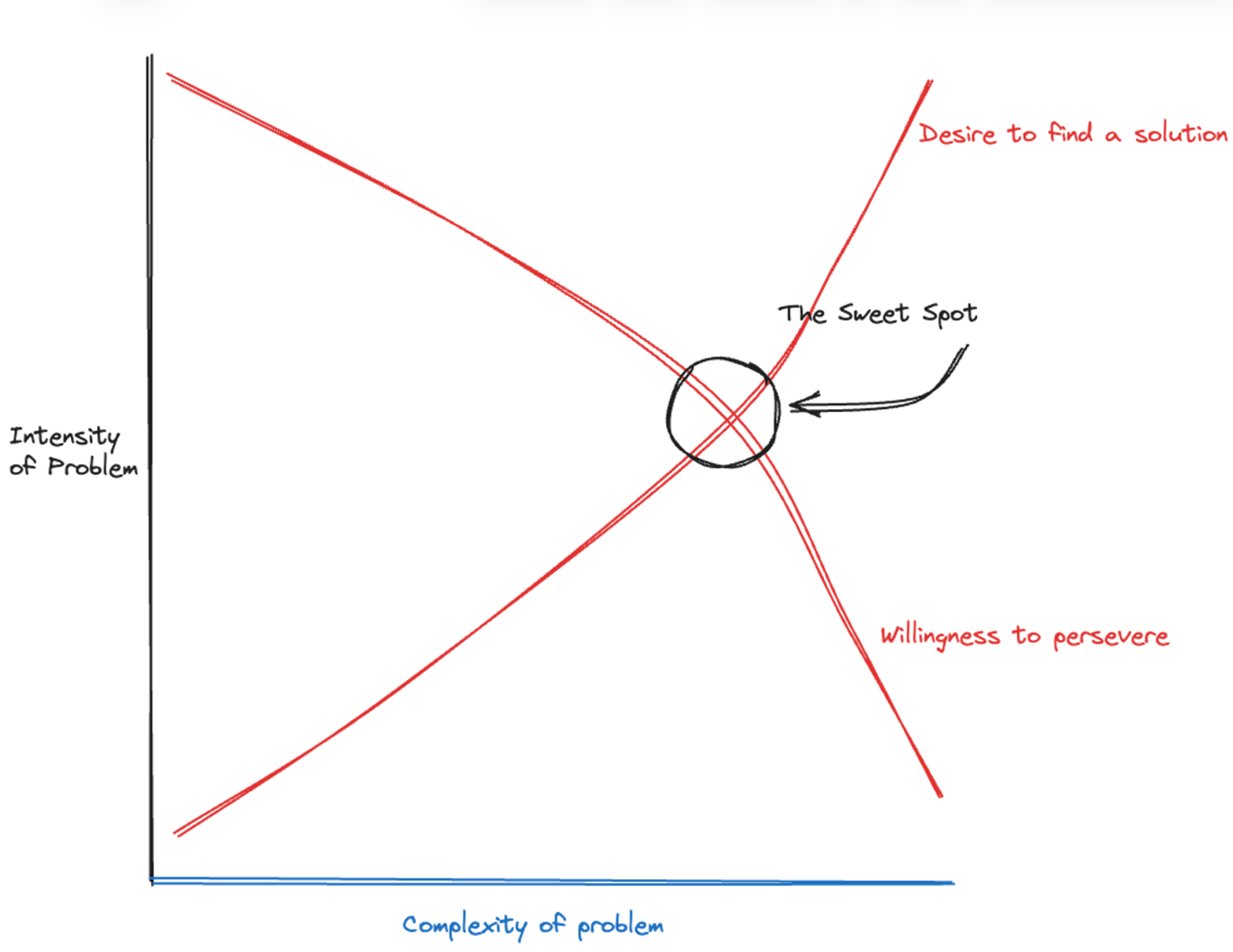
Illustration of Sweet Spot My plan to help participants identify wicked problems was successful, and they chose several challenging problems.
Their excitement, then frustration, then determination to continue was evident in all the right parts of the presentation.
This complements recent conceptualizations of principal–AI use that have so far focused mainly on AI as a tool for instructional efficiency and data driven decision making (Bixler & Ceballos, 2025), and responds to calls for more research on how human–AI collaboration can enhance creativity and higher order thinking in learning environments (Mariyono & Nur Alif Hd, 2025).
One principal participant noted, “I know that there are better ways to use it and I need more training to incorporate those things into my practice.”
Participants’ self-described solutions to their identified wicked problem are in Table 10.
Even though I did not request the information in order to demonstrate participants’ creativity and higher-order thinking required to solve their problems, it was nevertheless evident.
Table 10
Wicked Problem and Innovative Solutions Generated by Participants
| Wicked Problem | AI-Supported Solution |
|---|---|
| I want to increase community involvement and engagement. | Developed guiding questions and identified potential venues for family events. |
| I want to help my high school students to reflect on their interests and questions. | Created a one-month “Curiosity Tracker” tool for high school students to log and reflect on their interests and questions. |
| I want to help school principals tailor learning experiences for students. | Designed an app concept called “Personalizing Student Learning” aimed at helping principals tailor learning experiences. |
| There’s a trust problem in my school context; I need to understand the components and causes. | Built a flow chart that maps out the components and causes. |
| I want to address students’ emotional and mental state. | Proposed an app that forces a pop-up on students’ browsers prompting them to complete a Google Form (e.g., check-ins, surveys, or tasks) about their mental health status. |
| Our students need to learn about digital citizenship and I want to improve the use of 1:1 devices. | Began designing a game/application where students progress through levels to learn about digital citizenship. |
| I want to help school leaders manage workload and combat isolation. | Compiled a list of possible prototype support solutions to help school leaders manage workload and combat isolation, organized into a “Big/Easy” prioritization chart. |
| I want to increase engagement and feedback from the principals in my district. | Created a reflection form intended to increase engagement and feedback from principals. |
| I want to enhance students’ digital literacy and digital citizenship skills. | Started two different versions of a game focused on digital literacy and digital citizenship skills. |
| Students need to understand digital citizenship concepts. | Attempted to build another website/game using Replit to review digital citizenship concepts. |
| I want to help students write more effectively in history class. | Designed a tutoring tool or system to help students write more effectively in history class. |
During the workshop, each participant got to a point where they were frustrated and then persevered.
As I explained in Chapter 3, this frustration and perseverance is key to any innovation process.
Participants overcame the initial hurdle of getting AI to do what they needed it to do and then continued on with more confidence.
Each one left the session with a sense of determination to continue working on it.
In Chapter 5, I discuss the results and offer recommendations based on them.
Chapter 5: Discussion
In the previous chapters, I have detailed the current state of AI and discussed research on AI.
I offered methodological considerations and gave a brief overview of the results.
In this chapter, I hope to answer the question, “So, what now?”
I started out this dissertation wondering if principals could use AI for innovation, or if it was destined to be used just for efficiency.
In the time that has passed since starting this project, there have been many new AI tools, resources, models, and companies that have been created or evolved.
This is a very fast-moving field; in fact, OpenAI has released several innovations in the past few months.
On August 7, 2025, GPT-5 was released; September 30, 2025 saw the release of a powerful video generator.
On November 12, 2025, GPT-5.1 was announced as a smarter, more conversational ChatGPT, and on December 2, 2025, less than a month later, OpenAI released a “code red” version of ChatGPT 5.2, feeling pressure from other big AI companies, including X, Meta, Google, and Anthropic, not to mention many Chinese firms releasing open-weight models that can be run locally (OpenAI, 2025).
This pace of change reflects how AI is a rapidly expanding set of tools that can replicate increasingly complex human cognitive tasks and reshape learning environments: “We designed GPT 5.2 to unlock even more economic value for people; it’s better at creating spreadsheets, building presentations, writing code, perceiving images, understanding long contexts, using tools, and handling complex, multi-step projects” (OpenAI, 2025).
Do you feel the pace of change?
It’s easy to get lost in all that they can do.
Every day it takes me to write this, there is more to add to this section!
The point is, AI is advancing rapidly, and while it is a tragedy this will be out of date the moment it is published, that is also the reality of the pace of change of these tools!
Yet broader discussions of AI in education similarly argue that while specific tools will change rapidly, the core needs–ethical frameworks, robust training, inclusive policies, and collaboration between educators and developers–are enduring (Mariyono & Nur Alif Hd, 2025).
As this was a dissertation in practice, which requires me to ascertain the experience of the training and research process, there are several things that are worth mentioning.
First, I have observed that principals in trainings like the one in this study experience a peak and valley of emotions.
They start off scared about what AI can do, then they feel like it can do anything, then they focus on a specific problem and realize it is not as good as they originally thought, and finally, they feel a sense of accomplishment after wrestling with it to get it to do what they wanted.
This affective “rollercoaster” is consistent with broader themes of excitement and anxiety among educators and leaders, including worries about role displacement, loss of agency, and impacts on wellbeing (Fullan et al., 2023; Mariyono & Alif, 2024).
Figure 5 illustrates this process, how participants exhibited anxiety, elation, frustration, and concern.
They asked questions like, “Is there any hope for us to overcome AI?” and “What are we going to do to keep our kids from just using this to do all their work for them?”
They expressed excitement by saying things like, “I can have this put together my whole newsletter just by giving it a few bullet points” and “I don’t put my foot in my mouth as much because AI tells me how to write emails with attitude.”
They also made statements like, “I’m excited for AI, but also scared of it.”
In addition to these comments, their body language revealed feelings: sometimes a participant would jump out of their seat with an idea and run to someone else in the room to share what they were doing.
Other times, a participant would bang the table in frustration or close their laptop lid or do a classic dopamine-seeking behavior of looking at social media or catching a football game score.
In the discussion that follows, I explain how I perceived their response to my intentional efforts to help them see AI in a different way.
The Value of Focusing on One Problem
Asking principals to focus on a specific problem to solve during my workshop was very valuable because it helped participants know what they were trying to accomplish and to consider how to right-size the issue they would pursue.
The problem had to be more complex than asking AI to simply author an email for them.
It needed to have depth and complexity or it would not work to help them explore the tool’s potential for innovation.
I knew they needed to experience some productive struggle to get on to the next idea.
This caused two reactions in participants.
First, it made them frustrated that AI “was not working” and forced them to rethink either the problem or the proposed solution.
Second, it made them feel a sense of success and power as they overcame an initial failure to have a better experience on their second or third attempts.
One participant said, “I didn’t get it to work, but I know what I need to work on later.”
This workshop design was intentionally aligned with research on self-directed, problem-based professional learning, which emphasizes that effective learning for leaders is goal- oriented, grounded in authentic problems of practice, and iterative (Bixler & Ceballos, 2025; Fullan et al., 2024).
Observed Shifts in Demeanor Throughout the workshop, participants demonstrated changes in demeanor, as shown in Figure 5, below.
While I am not an emotions researcher and this is not an attempt to prove anything scientifically, I offer it because it was a meaningful result from what I planned and observed.
I intentionally plan my presentations to guide people through an experience like this.
I want them to experience highs and lows and feel challenged and excited.
Figure 5
A Visual Representation of the Affective Rollercoaster Most Participants Experienced
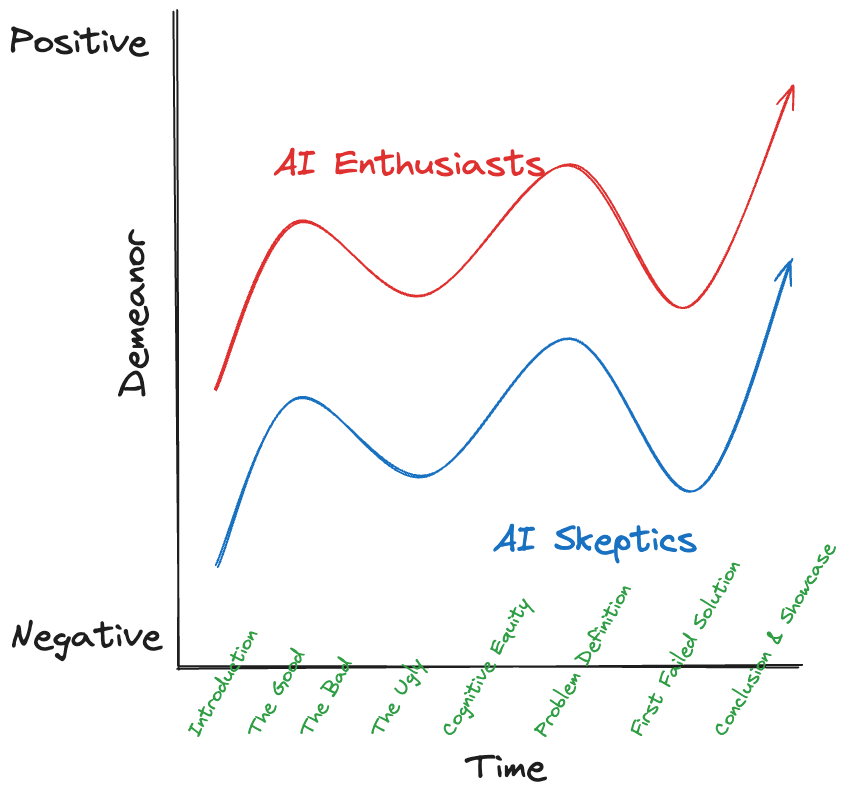
A Visual Representation of the Affective Rollercoaster Most Participants Experienced The astute observer will notice that both enthusiasts (people who came into the training excited about what AI can do) and skeptics (people who came into the training unsure if AI is really the future) followed a similar pattern.
That is because I intentionally designed the experience to challenge both enthusiasts and skeptics.
AI Enthusiasts are the top line, and AI skeptics are the bottom line.
Across the X axis, are certain points in my presentation, which you can see more of in the abbreviated presentation slides in the appendix.
AI enthusiasts began the day with guarded optimism, represented by the upper line starting slightly above neutral during the workshop introduction.
As they encountered compelling demonstrations of AI’s capabilities (“The Good”) their demeanor quickly rose, reflecting excitement and curiosity about what might be possible.
During “The Bad” and “The Ugly,” when limitations, ethical concerns, real consequences, and implementation challenges were surfaced, their demeanor dipped but generally remained in the positive range.
Participants said things like, “We should just ban [AI] if this is what happens.”
The subsequent section on cognitive equity and the intentional framing of AI as a tool to free up mental space for deep innovation work led participants to another demeanor shift, as they see how AI can align with their core values as educators and leaders, rather than compete with them.
This framing is consistent with positioning AI to “augment human intelligence” rather than replace it, which allows principals to offload some complex cognitive work while retaining human judgment (Fullan et al., 2024).
AI skeptics, represented by the lower line, began the day at a more negative or ambivalent place.
The introduction and early demonstrations elicited concerns about job displacement, loss of human connection, or the perceived “black box” nature of AI, resulting in an early emotional valley.
As the session moved into cognitive equity and then problem definition, skeptics experienced both the frustration of confronting messy, ill-structured problems and the gradual realization that AI could be constrained and directed toward locally meaningful goals.
Their line remained lower than that of the enthusiasts, but it followed a similar oscillating pattern, with each low point followed by a modest increase as they saw how AI can be used to solve wicked problems.
The lowest emotional point for both groups typically occurred around the first failed solution, when participants recognized that their initial prompts or designs did not yet yield the nuanced, contextually appropriate responses they had hoped to receive.
This moment of failure and productive struggle was central to the design of the training as it forced participants to refine their problem framing, clarify constraints, and engage more thoughtfully with the tool.
As they iterated, tested, and eventually produced a more useful output—often still imperfect, but noticeably better—their affective trajectories turned sharply upward.
By the conclusion and showcase, both AI enthusiasts and skeptics showed higher levels of confidence and a greater sense of agency than they had at the start of the day.
While it was beyond the scope of this dissertation’s design to systematically measure participants’ affective responses toward AI, future efforts to measure affect— through validated attitude or affect scales administered before, during, and after similar trainings—would be valuable.
This is especially relevant given emerging concerns about the relationship between AI and subjective well-being.
In a paper about using AI for decision-making, Viberg, et al (2024) offer, “the digital well-being of vulnerable students should be viewed holistically with their overall well-being, recognizing the complexity and intersectionality of their vulnerabilities, and stress the need to involve the students in designing and evaluating such systems” (p. 1977).
Finding a Way Forward
When provided with this kind of professional development, principals can start to see how to use AI for innovation, and not just for efficiency.
Throughout the day, participants needed several prompts to think more deeply about how to engage with AI in a deeper and more profound way.
When I asked for examples of what they might explore, I challenged them to reconsider the problems they were trying to solve.
One participant wanted to solve a student’s misuse of technology by composing an email explanation of why it was problematic.
Sure, AI can do that, but is that going to actually solve the problem?
He admitted he knew it would not, but he did not have other ideas for what to use AI to do.
With coaching, he ended up creating a game for his students to play that could help them learn about digital citizenship in an interesting and fun way, because that was the real problem he wanted to solve.
In the old days just three short years ago, this principal would not have had the time, expertise, money, or knowledge to make any kind of app. He would have just done a digital citizenship lesson how he always did it before.
But now, he can do something different.
Perhaps the old way worked, and it was fine.
But now he has two ways to deliver this content and help kids.
AI is powerful on its own, but it becomes really powerful when you are an expert guiding it.
This principal, an expert in teaching digital citizenship to students, can make something new to reach them, even though he does not have an expertise in that particular area.
This is what Bixler and Ceballos call using leading AI.
I challenged participants not to turn back to simple problems and avoid the deeper challenges that exist in schools.
We might want quick solutions, but wicked problems require more than that.
By and large, participants found ways to solve wicked problems, even if those solutions were imperfect.
They certainly got started on a path to solutions.
This echoes work suggesting that principals can lead AI implementation when conceptualized as a comprehensive resource for addressing complex instructional and organizational needs, not merely for automating routine tasks (Ceballos & Bixler, 2024; Fullan et al., 2024).
As expected, time was a major issue.
Time is a barrier, time is a support all principals wish for more of, and more time is a cultural shift that will happen if principals use AI for innovation.
The benefit of this six-hour professional development workshop was that principals had some time to use the tools away from their campus and everyday distractions.
This is what Cal Newport calls Deep Work: “Professional activities performed in a state of distraction-free concentration that push your cognitive capabilities to their limit.
These efforts create new value, improve your skill, and are hard to replicate” (Newport, 2016, p. 2).
When principals say they need time, this is what I believe they really and that is exactly what I designed my session to do for principals.
During the afternoon, they had most of the time to just work on their problem.
They talked about it, took breaks, and worked with AI tools appropriate for their wicked problem.
The training was six hours, with a working lunch, and less than half that time was lecture or me doing the talking.
They had lots of unstructured time to work on the things they needed to accomplish their project.
This aligns with research on effective principal learning that emphasizes job-embedded, problem-based, and sustained opportunities rather than one-off, lecture-heavy workshops (Berkowitz, 2012; Bixler, 2024; Darling-Hammond et al., 2022; Zepeda et al., 2014).
It is my sense that the experience of deep work and time to do it was the most valuable aspect for principals in this workshop. Not a single person left with a fully completed solution, and none of them were disappointed about that.
To the contrary, they were eager to continue working on it and try new things they had not yet considered.
During the showcase portion, each person briefly described their project and said something similar to “I know what else I need to do finish this.”
Limitations
This study focused on a small group of principals in rural Wyoming, and therefore, these ten principals’ experiences cannot be generalized broadly.
All of the data come from a single professional learning experience in a single site, delivered in a pre-conference environment that removed principals from their daily building pressures.
In addition, the participants represented a self-selected group of innovators who were willing to attend a six-hour AI workshop on a Saturday when they could have been relaxing with their families.
Their willingness to give up personal time and lean into a new topic suggests that they were more open to change and experimentation than the average principal, which limits transferability of this study’s findings to less enthusiastic or more skeptical leaders (Han et al., 2023).
There was also no comparison or control group. I did not compare these principals with others who did not receive the training or who experienced a different kind of professional development, so I cannot rule out alternative explanations for their perceived growth, such as their previous exposure to AI or peer influence.
With only ten usable surveys, the quantitative findings are underpowered for robust inferential statistics and are best interpreted as exploratory and descriptive rather than definitive.
Another limitation of this study is that I, Jethro Jones, conducted the full-day presentation with my own biases about education and AI embedded in the design and delivery.
I have a clear bias toward innovation instead of efficiency because I personally believe that certain practices should not even be done in schools, even if they have been done for years.
For example, especially in the age of AI, focusing on final projects instead of the learning process is almost guaranteed to set students up for what traditional educators call “cheating,” which means students use AI to take shortcuts to finish problems.
This is because in traditional systems, educators focus on completion.
I disagree with this definition of cheating; I see students trying to check the box on assignments more quickly as wise work, rather than dishonesty.
Ironically, teachers often agree with me when they are using AI to get their own work completed in a more efficient manner.
I also emphasize what I view as the hypocrisy of “AI for me but not for thee,” when teachers use AI to make lesson plans, handouts, and grades (or even to check for plagiarism) but prohibit students from using AI for their work (Romero, 2023).
More broadly, I favor project-based learning and mastery-based assessment.
These biases are clearly stated in my presentation, and they shape the assumptions I make as I teach.
Additionally, my presentation deliberately gave participants about half of the session time to think, talk, and research on their own.
I could have offered more direct instruction, but since that does not coincide with my beliefs about how to teach or learn, it would have been hypocritical to structure the workshop that way.
This inevitably leads to less time on explicit teaching of discrete skills, which may be optimal for learning certain kinds of content (for example, primary biological knowledge) but is not how I believe adults learn best.
Especially when they are dealing with wicked problems, like how to use AI in schools for both efficiency and innovation, especially when everyone is entering with very different starting levels (Berkowitz, 2012; Rowland, 2016; Zepeda et al., 2014); the way I taught the workshop was tailored to those realities.
The intervention is therefore tightly coupled to my personal facilitation style and design choices; replication by another facilitator might not produce the same experience or outcomes.
There are also limitations related to measurement and data sources.
Although the retrospective pretest–posttest instrument was adapted from established work, it was not formally piloted or psychometrically evaluated with this particular population, and the small sample size made such analysis impractical.
Evidence was limited to principals’ self-reported perceptions; I did not directly observe subsequent classroom or school-level changes, nor did I collect longitudinal follow-up data to see whether perceived gains persisted or translated into sustained practice, again, outside the scope of this dissertation in practice, which was solely looking at the practice of an AI for innovation professional development session.
A limitation of this study is that the training was not sustained, as in it was a one-off workshop. Research suggests a series of workshops would have been more effective.
Principal professional development should also fit “within the context of principals’ current lived experience with school issues, addressing principals’ needs,” (Bixler & Ceballos, 2025, p. 145).
The qualitative data consisted of short written responses to open-ended survey questions rather than interviews or focus groups, which constrained the depth and nuance of the themes that emerged.
I intentionally minimized demographic and contextual data collection to preserve anonymity and reduce participant burden, but this meant I could not examine how factors such as school level, years of experience, or community context may have shaped principals’ experiences with AI for innovation (Grissom et al., 2021).
I also did not systematically measure fidelity of implementation or the degree to which individual participants engaged in each phase of the design-thinking process, so I cannot say which specific elements of the training were most influential in shifting understanding or behavior.
A further limitation lies in my analytic approach.
I used AI-assisted coding in Atlas.ti as a support for my own qualitative analysis and then engaged a peer researcher to check and refine the codes.
Even with these safeguards, I recognized automated coding can overemphasize some ideas and underrepresent others, and dependence on AI within the analytic process should be acknowledged as a limitation (Mangal & Pardos, 2024).
Finally, the AI landscape is evolving rapidly.
New models, tools, policies, and public narratives about AI are emerging at a pace that virtually guarantees some concrete examples in this study will be outdated by the time it is read (Chiu et al., 2021; Fullan et al., 2023; Tomlinson et al., 2023).
Even with these limitations, I contend that this dissertation remains valuable.
The purpose of this work was not to produce generalizable claims about all principals nor to evaluate a particular AI product, but to closely examine how a small group of early-adopter principals experienced a deliberately designed professional learning environment that positioned AI as a resource for innovation rather than mere efficiency (Bixler, 2024; Fullan et al., 2023).
The combination of quantitative shifts in self-reported understanding, qualitative themes about supports and barriers, and a rich description of the training design offers a grounded, practice-oriented account of what it could look like when principals begin to use AI to tackle wicked problems in their own contexts.
For a dissertation in practice, that situated, experience-near knowledge is precisely the contribution: it provides a concrete, replicable model, surfaces real constraints and possibilities, and points the way for future studies that can extend, refine, and test these ideas with larger and more diverse samples over longer periods of time (Darling-Hammond et al., 2022; Grissom et al., 2021).
Implications
Despite the limitations listed above, there are clear implications from this dissertation in practice.
I offer several implications for practice and leadership derived from this analysis.
Specifically, I discuss repositioning AI, creating professional development (PD) opportunities that allow for deep work, framing AI around cognitive equity and design thinking, the affective rollercoaster, and how early adopter principals can model AI for innovation.
Repositioning AI Participants demonstrated this paradigm shift during the workshop. As one observed: The most useful stuff Jethro has probably made just solves Jethro, right?
And no one else would even want it.
So it is a waste of time to like market it to try and sell it.
So the cool thing is you used to have to depend on whatever vendor can sell you… Well, if you know what you want, you can build it yourself.
(Participant 1) Another participant captured the essence of this shift: “This is the new way of thinking.
We gotta teach kids how to think again” (Participant 2).
These statements capture the fundamental shift from viewing AI as a time-saver to seeing it as a tool for creating personalized, innovative solutions.
Firstly, there are two aspects to repositioning AI from a time-saving tool to an innovation partner.
Typically, in professional development within EdTech, a specific strategy or tool is taught, focusing on its usage.
This approach teaches individuals how to use the tool itself.
However, reframing AI as a problem-solving tool shifts the focus to addressing the problem first.
This process involves employing design thinking and recognizing that teaching a specific tool may not always be beneficial.
Conducting professional development with a problem-solving orientation makes it more challenging for presenters to solve each individual’s problem but empowers learners to solve their own issues.
When focusing on tools, individuals learn how to use them; when focusing on problems, they learn how to solve their problems.
This was evident in participants’ projects, which included various tools, some of which were not initially suggested.
This is consistent with research arguing that principals’ learning is most powerful when it is problem-based, job-embedded, and centered on real dilemmas of practice (Berkowitz, 2012; Bixler, 2024; Darling-Hammond et al., 2022; Zepeda et al., 2014).
The second aspect involves framing AI around cognitive equity and design thinking.
Presenting AI in this manner allows principals to perceive alternative methods of operation.
It underscores the importance of using AI for human-centered purposes— enabling more time for individual interactions, relationship building, and providing feedback and coaching.
AI should automate or expedite certain processes to allow more time for interpersonal engagements rather than merely increasing productivity.
Framing AI use from a cognitive equity and design thinking approach forces the user to see AI as more than just a time-saving tool, because cognitive equity expands the mind and design thinking focuses on the human experience.
As Fullan et al., 2024 write, School leaders need to create a long-term vision for integrating this technology into their schools in a careful but principled way.
Despite the allure and promise of this brave new AI/GenAI world, school leaders must always put the learning needs of children and young people first. (p. 342)
Provide Ample Time Another significant implication is the necessity of providing ample time during professional development for deep work, as evidenced by qualitative responses.
Principals require not just more time to do busy work or be lectured to, but intentional time dedicated to deep, essential work in a place that is away from their daily concerns.
This concept can be described as working on the school rather than merely working in it.
It involves stepping back to evaluate what is working and what is not and making time for improvements rather than continually addressing immediate problems.
Lecture-only or tool-focused workshops are unlikely to produce substantial changes in practice because participants often lack the time needed to practice and implement new information during these sessions (Darling-Hammond et al., 2022; Grissom et al., 2021).
Therefore, my intentional goal in this workshop was to provide ample unstructured time for participants to think, collaborate, ponder, test tools, and determine which ones were effective for them (Newport, 2016; Rowland, 2016).
Consider the Affective Roller Coaster The workshop captured a range of emotional responses as participants engaged with AI tools.
These ranged from uncertainty to triumph.
At the start, one participant asked, “Where do I start?”
(Participant 10).
When things did not work as expected, humor emerged: “You designed a beautiful black screen… that is a black screen of black screens” (Participant 10).
Participants acknowledged their limits: “I did run out [of time], I tried to get a little bit too much” (Participant 10).
Yet joy at accomplishment was evident: “I am so happy I got that” (Participant 10), as was wonder at what was possible: “It is incredible.
It really is…” (Participant 2).
This emotional range, from uncertainty to frustration to joy, represents the lived experience of learning to use AI for innovation rather than just efficiency.
Additionally, the affective roller coaster is an important consideration.
Learning to use AI for complex tasks involves predictable fluctuations in demeanor.
This PD intentionally normalized frustration and modeled perseverance; every participant experienced excitement and frustration regarding task completion at various points.
Frustration and failure are natural parts of the learning process; hence it is valuable for educational leaders to undergo this experience personally (Berkowitz, 2012; Fullan et al., 2023).
Finally, early adopter principals can utilize AI to become internal change agents who foster school cultures of experimentation, collaboration, and student-centered design.
This was demonstrated by the group’s belief that increased collaboration and teacher buy-in would result if principals continued modeling innovative practices in their work, as explained in Chapter 4.
This observation was supported by both research and practical experience within the dissertation: principals’ practices around collaboration, professional learning communities, and strategic use of new tools can have substantial downstream effects on teachers and students.
Research bears this out: “a principal’s ability to create positive working conditions and collaborative, supportive learning environments plays a critical role in attracting and retaining qualified teachers and developing their skills” (Darling-Hammond et al., 2022, p. 1).
Based on this experience, I believe that two critical issues often overlooked in professional development are: 1) Focusing on solving problems rather than merely teaching tools or specific strategies; and 2) Providing sufficient time during workshops for participants so they can human-centered approaches to address real issues they face (Bixler, 2024; Darling-Hammond et al., 2022).
Furthermore, the workshop demonstrated the value of productive struggle, which cannot happen without focusing on solving problems or giving time.
One participant’s journey through frustration to breakthrough illustrated this process.
Initially uncertain, she wondered, “So who’s to say that you are gonna like your idea and then have the wherewithal to make it” (Participant 2).
But persistence paid off: “I’m saying my 14-year-old daughter had the idea… And when you put it in Replit, you just said, I would like you to design… Exactly.
And I did it… It’s incredible” (Participant 2).
This led to a reframing of capability: “Here’s the thing.
Neither am I smart enough for this.
Because the tools exist for you to be able to do that” (Participant 2).
The same participant also worked through a mindset shift, noting, “So funny cause of course my old school, you know, almost 58-year-old brain, I walk in person and tell them cause I want the connection” (Participant 2).
The design thinking exercise produced authentic engagement with problem-solving.
During the empathy phase, participants identified teacher concerns, specifically focused in this instance on reimagining parent teacher conferences.
One participant noted the core tension: “Value versus time… Maybe a slow time like their family has their own night that they are now having to miss” (Participant 9).
During ideation, another suggested, “Yes.
And do it on nights.
There are games at your school because that is when you get the kids that never come to school, they go to the games” (Participant 8).
Building on this, a participant added, “Yes.
And let us feed the teachers while they are there at nights… And let us give them a day off to compensate them for the time spent” (Participant 9).
The group converged on a prototype when one stated, “I think you said it [referring to an idea earlier from another participant].
I think we take the list and contact those parents directly” (Participant 10).
The final showcase revealed the range of innovative projects participants created.
One participant focused on community engagement: “It would also add me come up with a parent advisory of the demographics of our Riverton, which would be really difficult, but I think we could do it” (Participant 7).
Another tackled digital citizenship: “I am trying to design a game application that students progress through levels to better inform them about digital citizenship” (Participant 8).
A third addressed leader isolation: “List of possible prototype support solutions for school leaders to manage the workload, combat isolation, built into a big slash easy chart” (Participant 3).
One participant explored multiple tools: “I did Mocha.
I built stuff, but I did not build anything like that [referencing another participant’s creation]… I kind of did both and mirrored them” (Participant 10).
Perhaps most striking was how the approach transferred beyond the workshop: “My 11-year-old son used GI Mocha with his voice and built a game on a web app that does grade level specific math fact review.
And then you earn points.
And then he built this little tank game” (Participant 1).
These projects demonstrate that with appropriate training and support, educational leaders can move beyond efficiency uses to genuine innovation with AI tools.
Recommendations
Numerous additional aspects of research could have been incorporated into this dissertation in practice but were beyond the study’s scope.
This section outlines several potential areas for further investigation.
First, conducting similar studies with larger and more diverse samples across various states and types of schools would be advantageous.
Understanding how different contexts influence responses to AI for Innovation training is crucial (Chiu et al., 2021; Han et al., 2023).
Additionally, a longitudinal follow-up study within six to twelve months would be beneficial to determine which practices persist and whether the workshop’s impact endured over time (Darling-Hammond et al., 2022; Grissom et al., 2021).
Although this dissertation did not include such a follow-up, I plan to engage with the principals at a future conference to gather insights on the long-term benefits and implementations of the training.
Another area omitted from this study was the systematic measurement of affective responses toward AI, including attitudes, anxiety, and confidence before, during, and after professional development sessions.
Utilizing a five-point Likert scale to track emotional trajectories throughout the workshop would provide valuable data, especially in light of evidence that negative emotions and low self-efficacy can shape educators’ and students’ willingness to engage with AI (Chiu et al., 2021; Han et al., 2023).
Comparing different professional development designs also warrants exploration.
While this study focused on independent work and thinking time for AI innovation, examining other formats such as lectures or rapid-fire workshops could reveal which methods yield more durable changes in principals’ practices (Darling-Hammond et al., 2022).
Incorporating additional data sources like artifacts, prompt logs, and implementation case studies would enhance understanding beyond self-reported data, offering a clearer picture of how principals utilize AI in their schools (Bixler, 2024; Mariyono & Hd, 2024).
Although briefly mentioned, an in-depth analysis of AI-supported qualitative coding was beyond this study’s scope.
The effectiveness of AI in qualitative coding remains an area ripe for further research.
My limited experience suggests that AI recommendations for coding are dependable; however, extensive evaluation is needed to confirm their value in the analytic process and to ensure that automated techniques support research goals (Mangal & Pardos, 2024).
Furthermore, investigating the impact of principal training on teachers within their schools would be intriguing.
Each research project can generate numerous offshoots concerning implementation and effects, providing ample opportunities for continued research (Darling-Hammond et al., 2022; Grissom et al., 2021).
Finally, this study did not delve deeply into principals’ explicit experiences with AI tools.
While their familiarity was assessed, varying levels of experience and prior usage were evident during sessions.
This suggests it would be useful to measuring current AI use among principals more comprehensively, especially in light of recent conceptual models that position principals as leaders of AI for instructional and organizational decision-making (Bixler, 2024; Chiu et al., 2021; Mariyono & Hd, 2024).
The rapid evolution of AI tools presents exciting opportunities for educational problem-solving.
The continuous development and distribution of new applications offer limitless potential for future research and practical implementation in education (Chiu et al., 2021; Fullan et al., 2023; Tomlinson et al., 2023).
Conclusion
Artificial intelligence (AI) presents significant potential as a tool, though its optimal utilization remains underexplored.
Initially, individuals are leveraging AI primarily for efficiency rather than innovation, focusing on expediting tasks without questioning the necessity of such tasks (Fullan et al., 2023; Mariyono & Hd, 2024).
Simply asking principals to reflect on their practice and consider whether they should even take a certain action can catalyze innovation.
For example, asking them to consider whether an email was the most effective way to respond helped principals think in more innovative ways.
This dissertation aimed to examine how school principals could employ AI for innovative purposes.
The findings indicate that the PD helped principals eventually use AI to devise novel solutions to complex problems within their schools.
Data from the sessions revealed that principals exhibited growth in understanding AI, with all participants showing increased comprehension.
Moreover, principals reported enhanced capabilities in applying AI for innovation, marking the most substantial improvement from the lowest initial levels to the highest final outcomes.
Key supports identified for principals included time, training, and collaboration, while primary barriers were time constraints and fear of uncertain outcomes.
Notably, the workshop provided the essential time required for principals to apply AI innovatively to their complex challenges (Bixler, 2024; Darling-Hammond et al., 2022; Grissom et al., 2021).
To address these intricate issues, principals need dedicated time for deep work and experimentation.
They must identify a balance between sufficiently complex problems and manageable solutions to facilitate actionable outcomes.
Overly complex problems can be overwhelming, while overly simple ones may lack credibility.
Principals concluded the training with imperfect but practical solutions and demonstrated motivation to continue refining these approaches, anticipating increased teacher engagement and improved collaborative culture within their schools (Fullan et al., 2023; Newport, 2016).
The concept of productive struggle is often discussed in education but seldom applied to adult learning.
This workshop provided such a struggle, resulting in participants feeling more adept at using AI for innovation (Berkowitz, 2012; Rowland, 2016).
Despite limitations such as a small, self-selected sample in a single setting with self-reported data amidst a rapidly evolving AI landscape, examining early adopters’ practices remains valuable (Chiu et al., 2021; Fullan et al., 2023; Tomlinson et al., 2023).
Future research should explore longer timeframes and diverse contexts to support various learners (Chiu et al., 2021; Han et al., 2023).
School districts should allocate time for principals to engage deeply with their work, emphasizing collaboration and sustained effort (Darling-Hammond et al., 2022; Grissom et al., 2021).
Principal preparation programs should integrate AI appropriately into their curricula so that principals are prepared to lead AI in ways that support instructional goals, equity, and innovation (Berkowitz, 2012; Bixler, 2024; Darling-Hammond et al., 2022).
Researchers must continue investigating attitudes and strategies related to AI in education, including how human–AI collaboration can best enhance creativity, critical thinking, and complex problem-solving.
From teaching AI in this format, it is evident that single professional development (PD) sessions are insufficient; follow-up is crucial.
A subsequent session with this group of Wyoming principals is scheduled for one year after the initial training at the same conference.
Although additional follow-up extends beyond this dissertation’s scope, its value is undeniable and mirrors broader calls for sustained, coherent leadership development rather than isolated events (Darling-Hammond et al., 2022; Zepeda et al., 2014).
While complete understanding and effective strategies for integrating AI are still developing, it is clear that AI will continue evolving.
Our commitment should remain focused on using AI to enhance human capacity rather than diminish it.
Principals play a vital role in stewarding this objective within their schools.
References
-
AFSA Web Administration. (2023, June 26). Artificial intelligence and education. American Federation of School Administrators. https://www.theschoolleader.org/news/artificial-intelligence-and-education
-
Ari, A. (2025). Implementation of artificial intelligence and the roles of educational leadership: Investigating the expectations of kindergartens’ principals. International Journal of Instruction, 18(4), 269-282. https://e-iji.net/ats/index.php/pub/article/view/818
-
August, S. E., & Tsaima, A. (2021). Artificial intelligence and machine learning: An instructor’s exoskeleton in the future of education. In J. Ryoo and K. Winkelmann (Eds.) Innovative learning environments in STEM higher education: Opportunities, challenges, and looking forward (pp. 79-105). Springer International Publishing.
-
Barr, A. (2025, April 25). ChatGPT is crushing Google in the AI race. Unless you look at the data differently. Business Insider. https://www.businessinsider.com/chatgpt-crushing-google-ai-unless-you-look-data-differently-2025-4
-
Berkowitz, M. W. (2012). Moral and character education. In K. R. Harris, S. Graham, T. Urdan, S. Graham, J. M. Royer, & M. Zeidner (Eds.), APA educational psychology handbook, Vol 2: Individual differences and cultural and contextual factors. (pp. 247–264). American Psychological Association. https://doi.org/10.1037/13274-010
-
Berkowitz, M. W. (2021). PRIMED for character education: Six design principles for school improvement (Kindle ed). Routledge.
-
Bessen, J. (2015). Toil and technology. Finance & Development, 52(1), 1. https://doi.org/10.5089/9781498351942.022
-
Bixler, K., & Ceballos, M. (2025). Principals leading AI in schools for instructional leadership: A conceptual model for principal AI Use. Leadership and Policy in Schools, 24(1), pp.137–154. https://doi.org/10.1080/15700763.2024.2428297
-
Braun, V., & Clarke, V. (2012). Thematic analysis. In H. Cooper, P. M. Camic, D. L. Long, A. T. Panter, D. Rindskopf, & K. J. Sher (Eds.), APA handbook of research methods in psychology, Vol 2: Research designs: Quantitative, qualitative, neuropsychological, and biological. (pp. 57–71). American Psychological Association. https://doi.org/10.1037/13620-004
-
Brown University. (2017, August 23). Even after reforms, few ineffective teachers are identified as ineffective, study finds. News From Brown. https://www.brown.edu/news/2017-08-23/widgeteffect
-
Bryant, D. A. & Walker, A. D. (2022). Principal-designed structures that enhance middle leaders’ professional learning. Educational Management Administration & Leadership, 52(2), 435-454. https://doi.org/10.1177/17411432221084154
-
Bryk, A. S. (2003). Trust in schools: A core resource for school reform. Educational Leadership, 60(6), 40–40.
-
Ceballos, M., & Bixler, K. (2024). Advancing instructional leadership: Instructional coaching skills development through mixed reality experiences. Journal of Educational Supervision, 7(1). https://doi.org/10.31045/jes.7.1.3
-
Chiu, T. K. F., Xia, Q., Zhou, X., Chai, C. S., & Cheng, M. (2023). Systematic literature review on opportunities, challenges, and future research recommendations of artificial intelligence in education. Computers and Education: Artificial Intelligence, 4, 100118. https://doi.org/10.1016/j.caeai.2022.100118
-
Christensen, C. M., Raynor, M., & McDonald, R. (2015). What is disruptive innovation? Harvard Business Review, 93(12), 44–53.
-
Clayton Christensen Institute. (2024, March 29). The different types of innovation. Christensen Institute. https://www.christenseninstitute.org/graphic/infographic-the-different-types-of-innovation/
-
Conway, M., & Ross, M. (1984). Getting what you want by revising what you had. Journal of Personality and Social Psychology, 47(4), 738–748. https://doi.org/10.1037/0022-3514.47.4.738
-
Coulter, S. E. (2012). Using the retrospective pretest to get usable, indirect evidence of student learning. Assessment & Evaluation in Higher Education, 37(3), 321–334. https://doi.org/10.1080/02602938.2010.534761
-
Darling-Hammond, L., Wechsler, M. E., Levin, S., Leung-Gagne, M., & Tozer, S. (2022, May 23). Developing effective principals: What kind of learning matters? Learning Policy Institute. https://doi.org/10.54300/641.201
-
Dehghani, M. (2025, July 25). A nice surprise that shouldn’t be! Missouri University of Science and Technology Chancellor Emails https://chancellor.mst.edu/emails/2025emails/07-25-2025/
-
Dong, Y., Dong, H., Yuan, Y., & Jiang, J. (2022). Role of peer coaching in transmitting the benefits of leader coaching. Frontiers in Psychology, 12, 679370. https://doi.org/10.3389/fpsyg.2021.679370
-
Drennan, J., & Hyde, A. (2008). Controlling response shift bias: The use of the retrospective pre‐test design in the evaluation of a master’s programme. Assessment & Evaluation in Higher Education, 33(6), 699–709. https://doi.org/10.1080/02602930701773026
-
Dyer, J. H., Gregersen, H., & Christensen, C. M. (2011). The innovator’s DNA: Mastering the five skills of disruptive innovators. Harvard Business Review Press.
-
Dynarski, M. (2016, December 8). Teacher observations have been a waste of time and money. Brookings Institution. https://www.brookings.edu/research/teacher-observations-have-been-a-waste-of-time-and-money/
-
Farnsworth, S. J., Hallam, P. R., & Hilton, S. C. (2019). Principal learning-centered leadership and faculty trust in the principal. NASSP Bulletin, 103(3), 209–228. https://doi.org/10.1177/0192636519871624
-
Flavin, M. (2021). Disruptive innovation and technology enhanced learning. Psychology of Education Review, 45(1), 17–26. https://doi.org/10.53841/bpsper.2021.45.1.17
-
Fuertes-Alpiste, M. (2024). Framing generative AI applications as tools for cognition in education. Pixel-Bit, Revista de Medios y Educación, 71, 42–57. https://doi.org/10.12795/pixelbit.107697
-
Fullan, M., Azorín, C., Harris, A., & Jones, M. (2024). Artificial intelligence and school leadership: Challenges, opportunities and implications. School Leadership & Management, 44(4), 339–346. https://doi.org/10.1080/13632434.2023.2246856
-
Garet, M. S., Wayne, A. J., Brown, S., Rickles, J., Song, M., Manzeske, D., & Ali, M. (2017). The impact of providing performance feedback to teachers and principals. National Center for Education Evaluation and Regional Assistance. NCEE 2018-4001.
-
Garza, E., Jr, Drysdale, L., Gurr, D., Jacobson, S., & Merchant, B. (2014). Leadership for school success: Lessons from effective principals. International Journal of Educational Management, 28(7), 798–811. https://doi.org/10.1108/IJEM-08-2013-0125
-
Girodano, N. (2020, Nov 13). Leadering: making peace with paradox: The RIFF model. https://nancygiordano.com/essays/a-new-tool-for-a-new-world-riff
-
Giordano, N. (2021). Leadering: The way visionary leaders play bigger. PBI Publishing.
-
Goedhart, H., & Hoogstraten, J. (1992). The retrospective pretest and the role of pretest information in evaluative studies. Psychological Reports, 70(3), 699–704. https://doi.org/10.2466/pr0.1992.70.3.699
-
Grissom, J. A., Egalite, A. J., & Lindsay, C. A. (2021). How principals affect students and schools: A systematic synthesis of two decades of research. The Wallace Foundation, http://www.wallacefoundation.org/principalsynthesis
-
Grissom, J. A., & Harrington, J. R. (2010). Investing in administrator efficacy: An examination of professional development as a tool for enhancing principal effectiveness. American Journal of Education, 116(4), 583–612. https://doi.org/10.1086/653631
-
Grissom, J. A., Loeb, S., & Master, B. (2013). Effective instructional time use for school leaders: Longitudinal evidence from observations of principals. Educational Researcher, 42(8), 433–444. https://doi.org/10.3102/0013189X13510020
-
Hallinger, P., & Heck, R. H. (1998). Exploring the principal’s contribution to school effectiveness: 1980‐1995∗. School Effectiveness and School Improvement, 9(2), 157–191. https://doi.org/10.1080/0924345980090203
-
Han, B., Zhang, J., Almodfer, R., Wang, Y., Sun, W., Bai, T., Dong, L., & Hou, W. (2025). Research on innovative Apple grading technology driven by intelligent vision and machine learning. Foods, 14(2), 258. https://doi.org/10.3390/foods14020258
-
Hansford, B., & Ehrich, L. C. (2006). The principalship: How significant is mentoring? Journal of Educational Administration, 44(1), 36–52. https://doi.org/10.1108/09578230610642647
-
Hao, Z., Miao, E., & Yan, M. (2021). Research on school principals’ willingness to adopt artificial intelligence education and related influencing factors. 2021 Tenth International Conference of Educational Innovation through Technology (EITT), 356–361. https://doi.org/10.1109/eitt53287.2021.00076
-
Ho, J. C. (2022a). Disruptive innovation from the perspective of innovation diffusion theory. Technology Analysis & Strategic Management, 34(4), 363–376. https://doi.org/10.1080/09537325.2021.1901873
-
Ho, J. C. (2022b). Disruptive innovation from the perspective of innovation diffusion theory. Technology Analysis & Strategic Management, 34(4), 363–376. https://doi.org/10.1080/09537325.2021.1901873
-
Hoerr, T. R. (2017). The formative five: Fostering grit, empathy, and other success skills every student needs. ASCD.
-
Hoerr, T. R. (2022). The principal as chief empathy officer: Creating a culture where everyone grows. ASCD.
-
Hu, K. (2023, February 2). ChatGPT sets record for fastest-growing user base—Analyst note. Reuters. https://www.reuters.com/technology/chatgpt-sets-record-fastest-growing-user-base-analyst-note-2023-02-01/
-
Information Architects. (2024, March 1). Authorship. https://ia.net/writer/support/editor/authorship?tab=mac
-
Jones, J. (2019, November 22). Psychological safety—what it is, why it’s important, and how to foster it. Have a Good Life Blog. https://jethro.site/2019/11/22/psychological-safety/
-
Jones, J. (2020). School X: How principals can design a transformative school experience for students, teachers, parents - and themselves. John Catt Educational LTD.
-
Jones, J. (2022). How to be a transformative principal. John Catt Educational Ltd.
-
Jones, J. (2023a). APLUS framework for adopting AI in K12 schools. https://doi.org/10.13140/RG.2.2.20981.28646
-
Jones, J. (Executive Producer). (2023b, January 21). ChatGPT is here, what are we going to do? With Damon Hargraves (No. 518) [Audio Podcast Episode] In Transformative Principal. Canon Solutions America https://transformativeprincipal.org/s10/518
-
Jones, J. (2025a). Cognitive equity: Enabling a young Woman with down syndrome to participate on the same rhetorical level as her peers (preprint).
-
Jones, J. (2025b, June 23). How principals can use artificial intelligence. [Paper Presentation] Virginia Association of Elementary School Principals Thrive in 2025, Virginia Beach, VA, USA.
-
Jones, J. (Executive Producer). (2025c, July 16). The new age of software in schools with Damon Hargraves (No. 670) [Audio Podcast Episode] In Transformative Principal. Canon Solutions America https://transformativeprincipal.org/s13/670
-
Kaminski, J. (2011). Diffusion of innovation theory. Canadian Journal of Nursing Informatics, 6(2), 1444. https://cjni.net/journal/?p=1444
-
Karakose, T. (2024). Will artificial intelligence (AI) make the school principal redundant? A preliminary discussion and future prospects. Educational Process International Journal, 13(2). https://doi.org/10.22521/edupij.2024.132.1
-
Kelley, C. J., & Finnigan, K. (2003). The effects of organizational context on teacher expectancy. Educational Administration Quarterly, 39(5), 603–634. https://doi.org/10.1177/0013161X03257299
-
Kosmyna, N., Hauptmann, E., Yuan, Y. T., Situ, J., Liao, X.-H., Beresnitzky, A. V., Braunstein, I., & Maes, P. (2025). Your brain on ChatGPT: Accumulation of cognitive debt when using an AI assistant for essay writing task (Version 1). arXiv. Cornell University. https://doi.org/10.48550/ARXIV.2506.08872
-
Leithwood, K., Seashore, K., Anderson, S., Wahlstrom, K., & Center for Applied Research and Educational Improvement. (2004). Review of Research: How Leadership Influences Student Learning. https://hdl.handle.net/11299/2035
-
Louis, K. S., & Murphy, J. (2017). Trust, caring and organizational learning: The leader’s role. Journal of Educational Administration, 55(1), 103–126. https://doi.org/10.1108/JEA-07-2016-0077
-
Magana, A. J. (2019). Disruptive classroom technologies. In G. Noblit (Ed.) Oxford Research Encyclopedia of Education. Oxford University Press. https://doi.org/10.1093/acrefore/9780190264093.013.423
-
Magaña, S. (2017). Disrupting low-impact technology use: Aligning visible learning and the T3 framework for innovation (1st ed). Corwin.
-
MagicSchoolAI. (2023, December 7). Introducing MagicSchoolAI 3.0 [Microblogging site Twitter]. X. https://x.com/magicschoolai/status/1732858946065428717
-
Mariyono, D., & Nur Alif Hd, A. (2025). AI’s role in transforming learning environments: A review of collaborative approaches and innovations. Quality Education for All, 2(1), 265–288. https://doi.org/10.1108/qea-08-2024-0071
-
Master, B. K., Schwartz, H., Unlu, F., Schweig, J., Mariano, L. T., Coe, J., Wang, E. L., Phillips, B., & Berglund, T. (2022). Developing school leaders: Findings from a randomized control trial study of the executive development program and paired coaching. Educational Evaluation and Policy Analysis, 44(2), 257–282. https://doi.org/10.3102/01623737211047256
-
Mitgang, L. (2012). The making of the principal: Five lessons in leadership training. The Wallace Foundation. https://doi.org/10.59656/EL-PP3171.001
-
MLFTC (2021). Framework for Principled Innovation. Arizona State University Mary Lou Fulton Teachers College. https://pi.education.asu.edu/wp-content/uploads/2021/04/19_20-Framework-for-Principled-Innovation.pdf
-
OpenAI. (2022a, July 20). DALL·E now available in beta. https://openai.com/index/dall-e-now-available-in-beta/
-
OpenAI. (2022b, November 30). Introducing ChatGPT. https://openai.com/index/chatgpt/
-
OpenAI. (2025, December 11). Introducing GPT-5.2. Releases. https://openai.com/index/introducing-gpt-5-2/
-
Pardosi, A., Benny, V., Xu, S., Umurohmi, U., Nurdiana, N., & Sabur, F. (2024). Implementation of an artificial intelligence based learning management system for adaptive learning. Al-Fikrah: Jurnal Manajemen Pendidikan, 12(1), 149. https://doi.org/10.31958/jaf.v12i1.12548
-
Pope, A. (2024, April 10). NYT v. OpenAI: The Times’s about-face. Harvard Law Review Blog. https://harvardlawreview.org/blog/2024/04/nyt-v-openai-the-timess-about-face/
-
Porter, M., & Dike, A. (2023). Assessing disruptive innovation research in management: A bibliometric analysis. Business Education Innovation Journal 15(149). 145-149
-
Pratt, C. C., McGuigan, W. M., & Katzev, A. R. (2000). Measuring program outcomes: Using retrospective pretest methodology. American Journal of Evaluation, 21(3), 341–349. https://doi.org/10.1177/109821400002100305
-
Quinn, T. P., Jacobs, S., Senadeera, M., Le, V., & Coghlan, S. (2022). The three ghosts of medical AI: Can the black-box present deliver? Artificial Intelligence in Medicine, 124, 102-158. https://doi.org/10.1016/j.artmed.2021.102158
-
Readwise Chat (Version o3). (2025). [Computer software]. Readwise. https://chat.readwise.io
-
Rogers, E. M. (2003). Diffusion of innovations (5th ed.). Free Press.
-
School Leader Collaborative. (2023, July). School leader paradigm: Becoming while doing. Association of Washington School Principals: School Leader Collaborative. https://awsp.org/resources/school-leader-paradigm/
-
SchoolAI. (2023, March 21). Coteacher helps you run your classroom better in fewer hours. SchoolAI https://web.archive.org/web/20230321194224/https://schoolai.com/
-
Schwarz, N., & Sudman, S. (Eds.). (1994). Autobiographical memory and the validity of retrospective reports. Springer-Verlag. https://research.ebsco.com/linkprocessor/plink?id=98cd6b71-cb1e-308b-9729-10502a25597e
-
Sheninger, E. C. (2019). Digital leadership: Changing paradigms for changing times (2nd ed). Corwin ICLE.
-
Sinek, S. (2019). The infinite game. Penguin.
-
Sivers, D. (2025, January 5). AI usage.
-
Smith, M. G., Bradbury, T., & Karney, B. R. (2024). Can generative AI chatbots emulate human connection? A relationship science perspective. PsyArXiv. https://doi.org/10.31234/osf.io/vyfa4
-
Stöffelbauer, A. (2023, October 24). How large language models work: From zero to ChatGPT. Data Science + AI at Microsoft. Medium. https://medium.com/data-science-at-microsoft/how-large-language-models-work-91c362f5b78f
-
Sutton, R. (2019, March 13). The bitter lesson. Incomplete Lessons. https://www.cs.utexas.edu/~eunsol/courses/data/bitter_lesson.pdf
-
Tomlinson, K., Jaffe, S., Wang, W., Counts, S., & Suri, S. (2025). Working with AI: Measuring the occupational implications of generative AI (No. arXiv:2507.07935). https://doi.org/10.48550/arXiv.2507.07935
-
Turchi, T., Faenza, F., Malizia, A., Bosio, G., & Bruno, N. (2025, June 16). Figmant—a plugin for end-user development of Wizard of Oz experiments for human-AI interaction design. [Paper Presentation] Joint Proceedings of IS-EUD 2025: 10th International Symposium on End-User Development. Munich, Germany.
-
Valera, C. (2023). An integrative literature review of collaborative school culture: Basis for a proposed model. Science Open Preprints https://doi.org/10.14293/PR2199.000439.v1
-
Viberg, O., Kizilcec, R. F., Wise, A. F., Jivet, I., & Nixon, N. (2024). Advancing equity and inclusion in educational practices with AI‐powered educational decision support systems (AI‐EDSS). British Journal of Educational Technology, 55(5), 1974–1981. https://doi.org/10.1111/bjet.13507
-
Wallace Foundation. (2009, March). Assessing the effectiveness of school leaders: New directions and new processes. The Wallace Foundation.
-
Wang, M., la Tour, T. D., Watkins, O., Makelov, A., Chi, R. A., Miserendino, S., Heidecke, J., Patwardhan, T., & Mossing, D. (2025). Persona features control emergent misalignment (version 1). arXiv. Cornell University. https://doi.org/10.48550/ARXIV.2506.19823
-
Warren, S. R., & Kelsen, V. E. (2013). Leadership coaching: Building the capacity of urban principals in underperforming schools. Journal of Urban Learning, Teaching, and Research, 9, 18-31.
-
Willison, S. (2023, August 27). Making large language models work for you. Simon Willison’s Weblog. https://simonwillison.net/2023/Aug/27/wordcamp-llms/#personal-ai-ethics
-
Willison, S. (2024, May 8). Slop is the new name for unwanted AI-generated content. Simon Willison’s Weblog. https://simonwillison.net/2024/May/8/slop/
-
Wiseman, L. (2017). Multipliers: How the best leaders make everyone smarter (Revised and updated edition). HarperBusiness.
-
Wiseman, L., & McKeown, G. (2010, May). Bringing out the best in your people. Harvard Business Review. https://hbr.org/search?term=R1005K
Appendix A: Professional Development Agenda
- What is AI? (Jethro Keynote)
- AI for Efficiency and Speed: What Can AI Do for Me? (Review & Share – current uses)
- But Should I Be Doing Those Things? (Jethro on Using AI to Solve Wicked Problems)
- Lunch + Facilitated Table Conversations
- Guided prompts: “Should I be doing those things?”
- Define a problem you want to solve this afternoon.
- AI for Innovation: The Design Thinking Process
- Explore on your own with [ChatGPT in study mode] (https://chatgpt.com/study)
- Explore on your own with SchoolAI
- Explore on your own with Stanford’s D.School
- Explore on your own with YouTube
- Demo: AI Tools for Innovation
- SchoolX Design Thinking GPT, Comet Browser, Hunch workflow, Replit site build.
- Work Time
- Resources:
- SchoolAI Space about creating your own app as a principal
- Replit: Make your own web app to solve your problem using AI
- Milestones:
- 5 min - Define your problem
- 15 min - Sketch your idea.
- 20 min - Build/Test it with AI.
- 10 min - Prepare a short share-out.
- Showcase
- Submit your work here.
- Individuals/pairs share results (gallery walk or turn-taking).
- Closing & Survey
- Jethro wraps up, shares takeaways, invites participants to survey.
- Dissertation Survey
Appendix B: Survey Questions
BEFORE the Training.
Please rate your proficiency where 1=not very well, 3=average, and 5=very well.
AFTER the Training.
Please rate your proficiency where 1=not very well, 3=average, and 5=very well.
- What supports will you need to continue using this Innovation with Al
problem- solving practice?
- What barriers do you foresee preventing you from continuing these
strategies?
- How do you expect the culture of your school to be impacted by your
continuation of these strategies?
Appendix C: Survey Responses
What supports will you need to continue using this Innovation with Al problem-solving practice?
- I will need to dedicate more time to experimenting with the various tools out there. There are so many ways to problem solve using these apps. I just need time to use these tools to identify and problem solve. More ongoing and specific PD would be helpful.
- Continued education about the advancements in AI will allow me to better use the platform for effective use.
- Follow through, seeing others’ examples
- I need more PD on how to effectively use AI in my setting. Continued hands on training.
- Please keep the links open. I will use your page as a reference to continue to try to use AI for innovation in a school setting for teachers and students.
- answers to questions, follow-up training, practice, practice, practice
- Time, knowledge of all the possible AI platforms that perform various tasks.
- Time. It is hard to use a tool if you don’t understand how to start. I think intent is there but execution is average.
- Practice and digging into the AI tools.
- Continue to be curious, learn and apply the design thinking process while leveraging tools to make it more efficient and impactful.
How do you expect the culture of your school to be impacted by your continued use of the AI Problem-solving practice?
- I expect the culture of my school to become more reflective, innovative, and student-centered through the continued use of these strategies. As staff and students engage in structured problem-solving and responsible AI use, our culture will shift toward one that values curiosity, ethical decision-making, and continuous improvement. Students will gain greater ownership of their learning, understanding that technology is a tool for creativity and collaboration rather than distraction. Teachers will feel more supported and confident integrating new approaches, and our school community will grow stronger through shared trust, accountability, and a collective focus on preparing students to think critically in an evolving world.
- I feel it will greatly benefit its real potential by letting our school know how it can be used as a resource for deeper thinking than just a way to do something easier.
-
More innovation, less fear
- Continued application for the problem of practice, how to effectively implement AI in a school setting. Teacher buy-in.
- I think the more I use and understand AI, the more I can help individualize education for all learners!
- I am hoping to bring it to the next level for inspiration, innovation, and culture.
- Improved use of technology for the betterment of the school function. Provide me more time to work with teachers than doing tasks that AI can perform.
- I would like to think that overall production and lowering of stress will be better with time-effective and AI-think shaping tools.
- My organization should be more active and members should see a greater value in belonging to WASSP.
- NA
What barriers do you foresee preventing you from continuing these strategies?
- It is simply an issue of time and ongoing support. The conference/training was incredibly helpful, but I need more continued time. Additional time with Jethro would be incredibly helpful. I sometimes also see money being a barrier. To utilize a lot of these tools effectively they cost money for the higher end subscriptions.
- I become fearful when the resource is designed without truly understanding its potential for benefit and for possible corruption.
- Lack of technical knowledge, access to other AI experts in my school community
- Time and money to use paid versions
- I don’t know what I DON’T KNOW!! Giving me a guide is a safe starting point for me to try AND to share the information to other early adopters of AI
- Time and tenacity for getting through the through the learning stage and to the point that it is helping me and saving me time.
- My own limited knowledge.
- Knowledge of which AI will produce what results. This helped, but I have a LONG way to go.
- Time
- time and other priorities.
Appendix D: Slide Deck (Abbreviated)
Slide 13

Slide 16

Slide 31
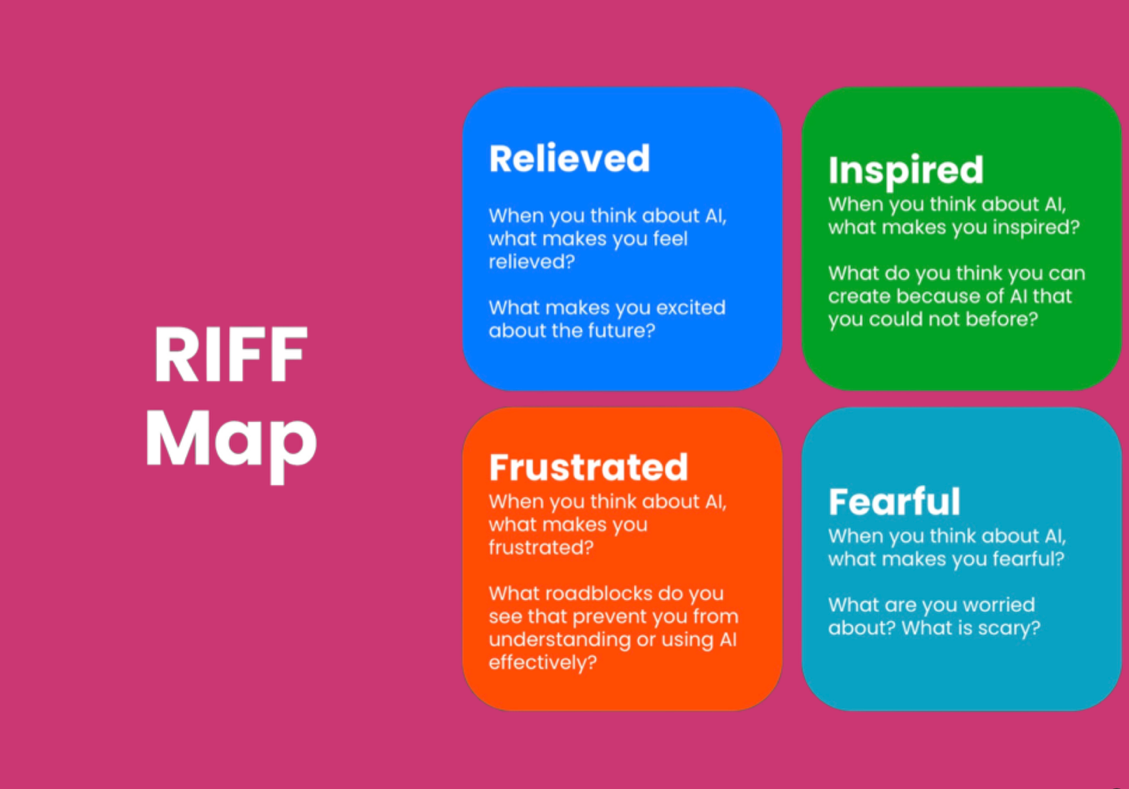
Slide 36
Slide 48
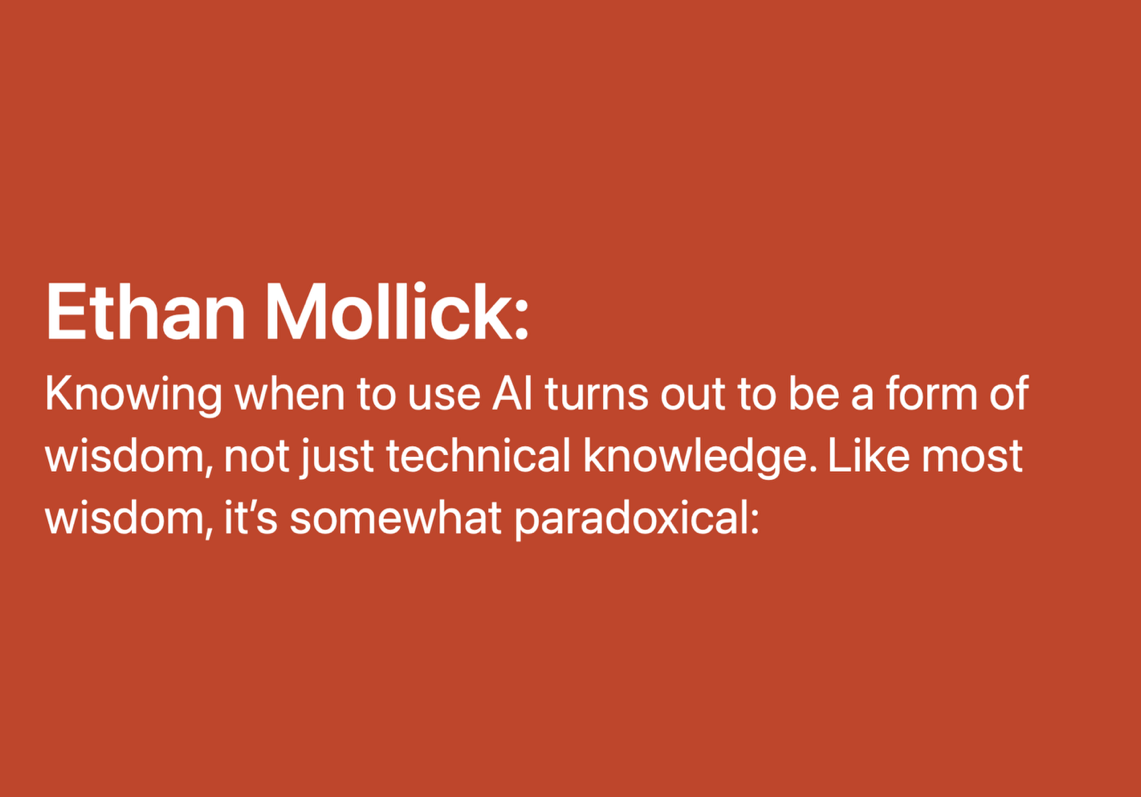
Slide 49
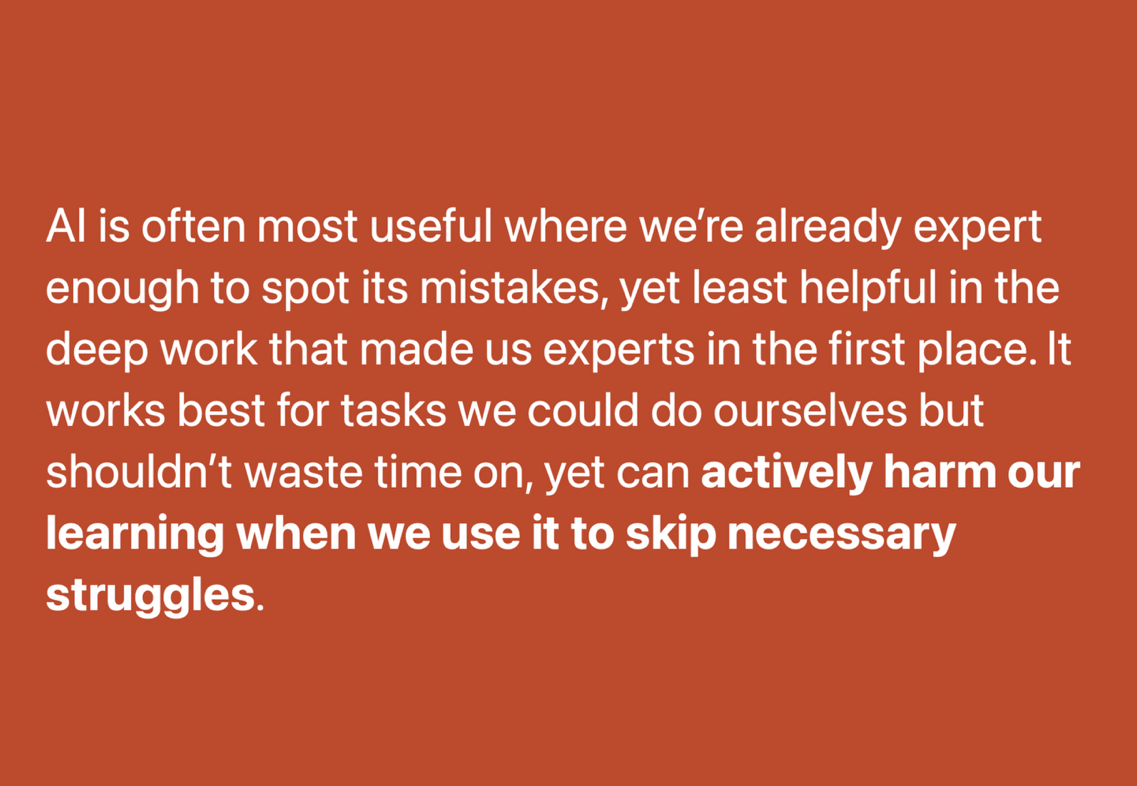
Slide 56
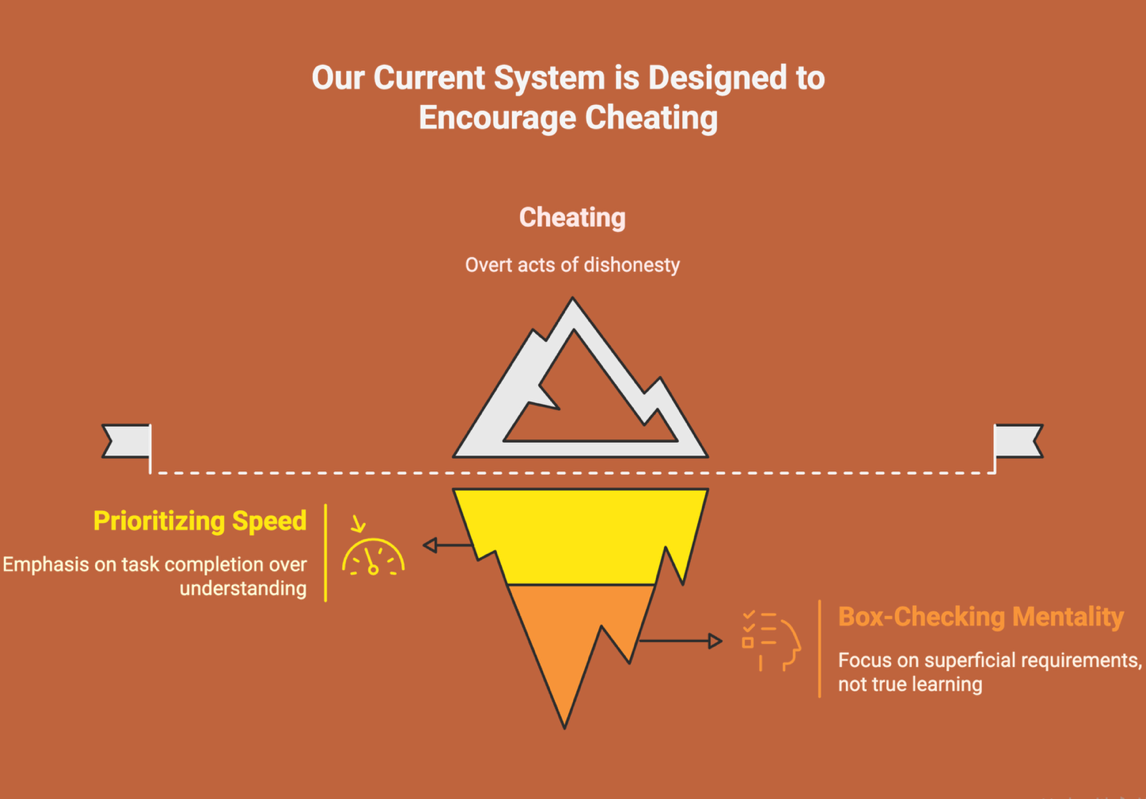
Slide 57

Slide 58

Slide 59
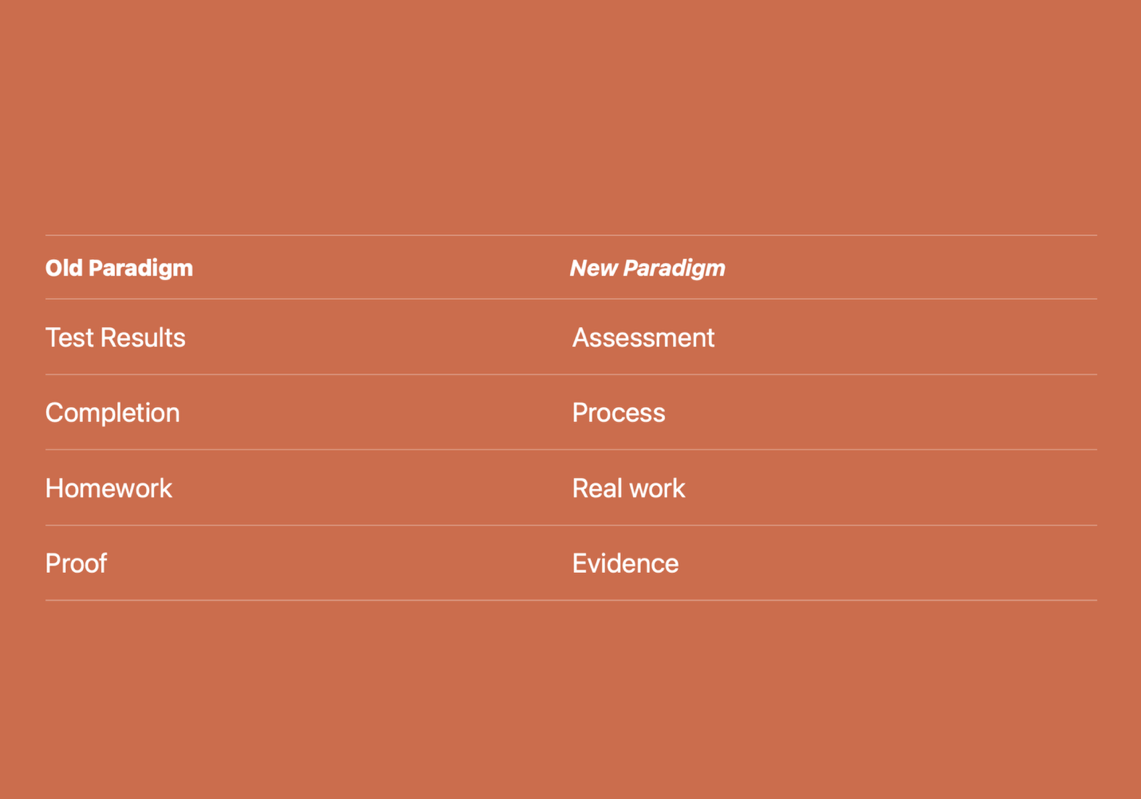
Slide 62

Slide 63
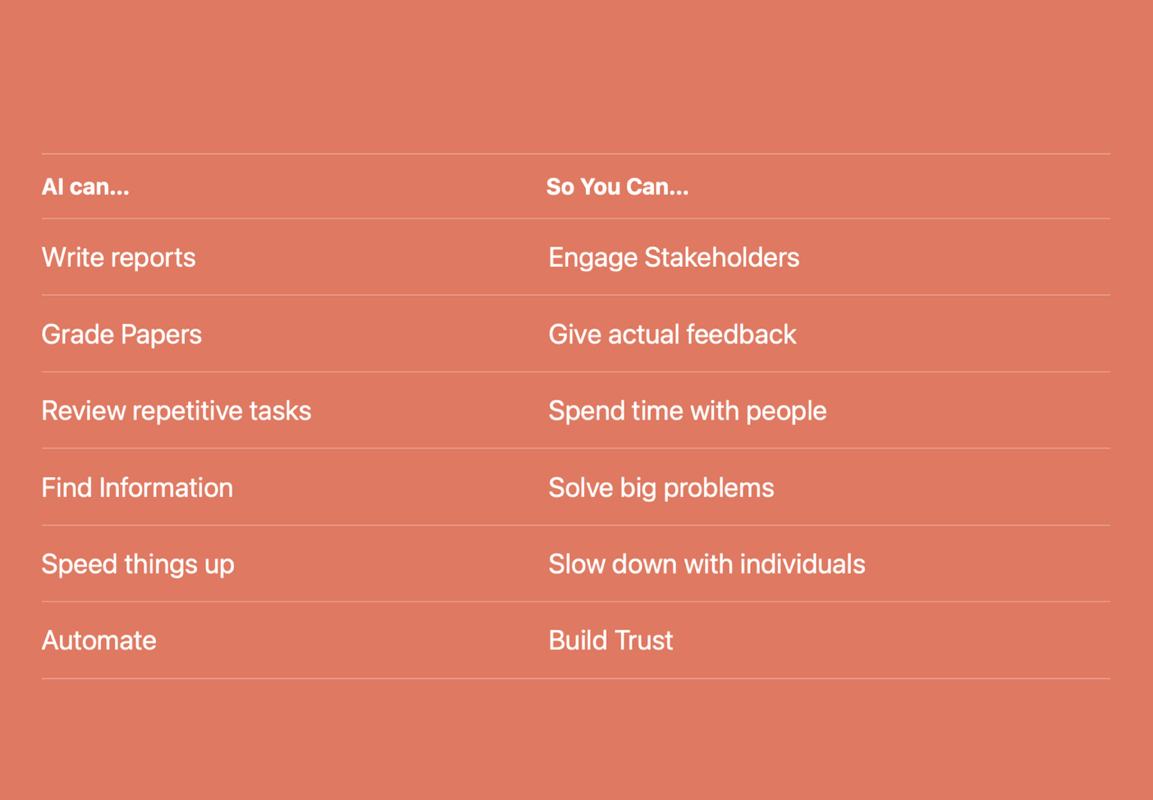
Slide 76

Slide 81
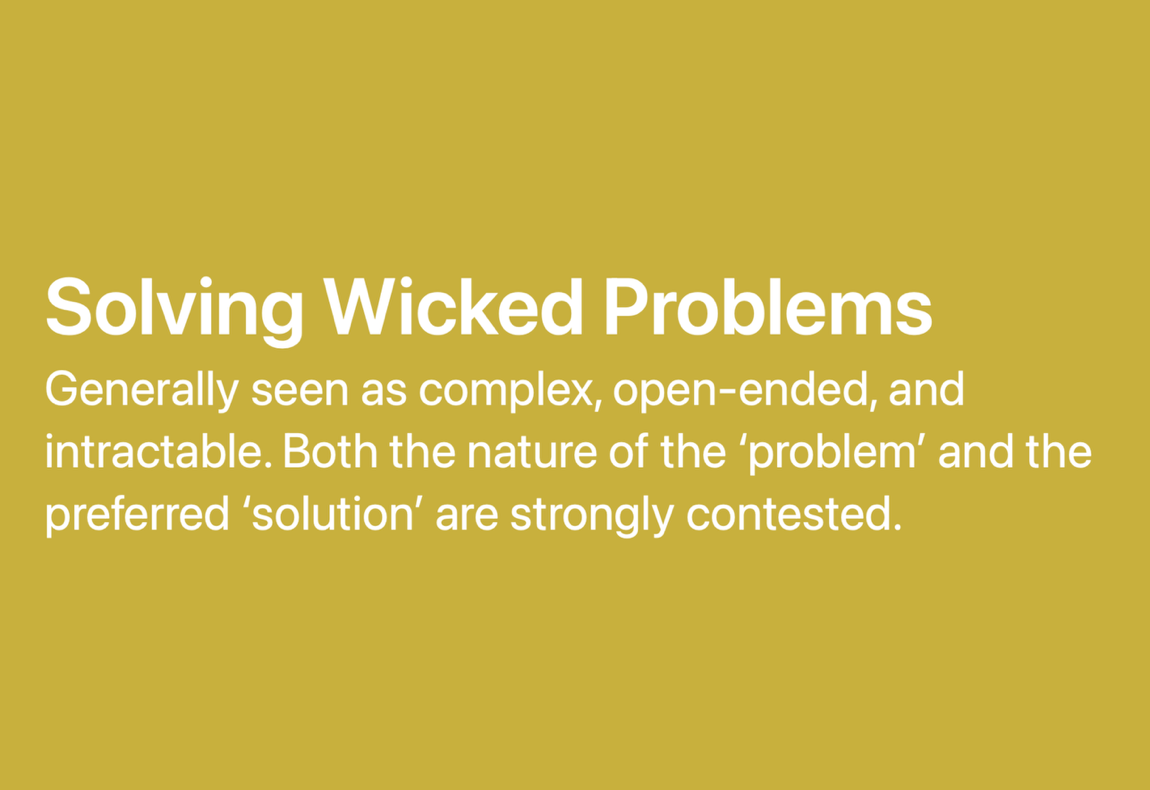
Slide 87
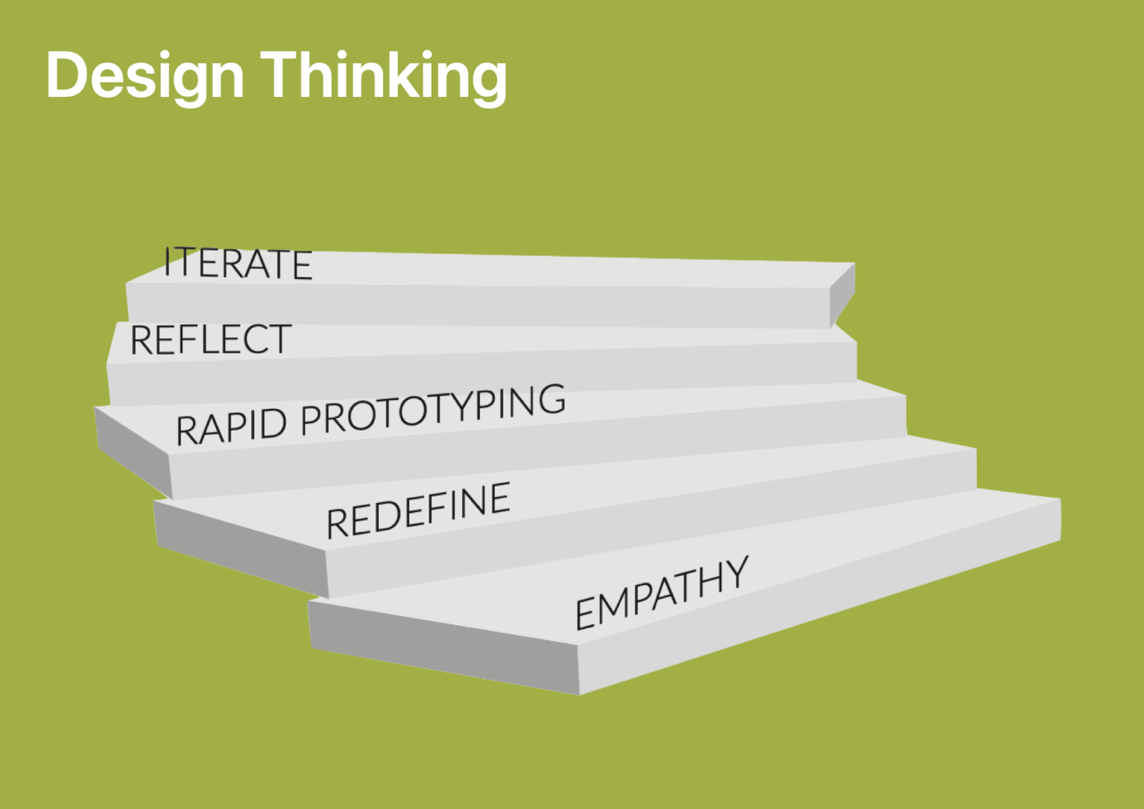
Slide 88
Slide 93
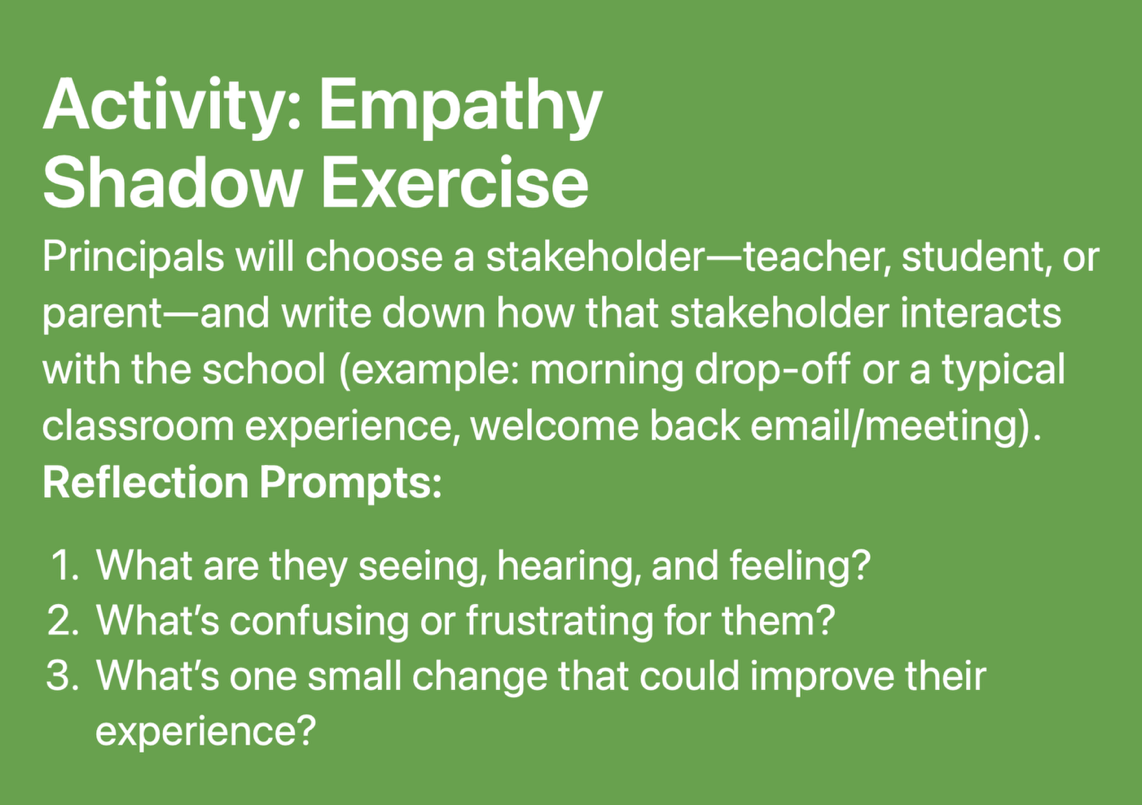
Slide 100
Slide 103